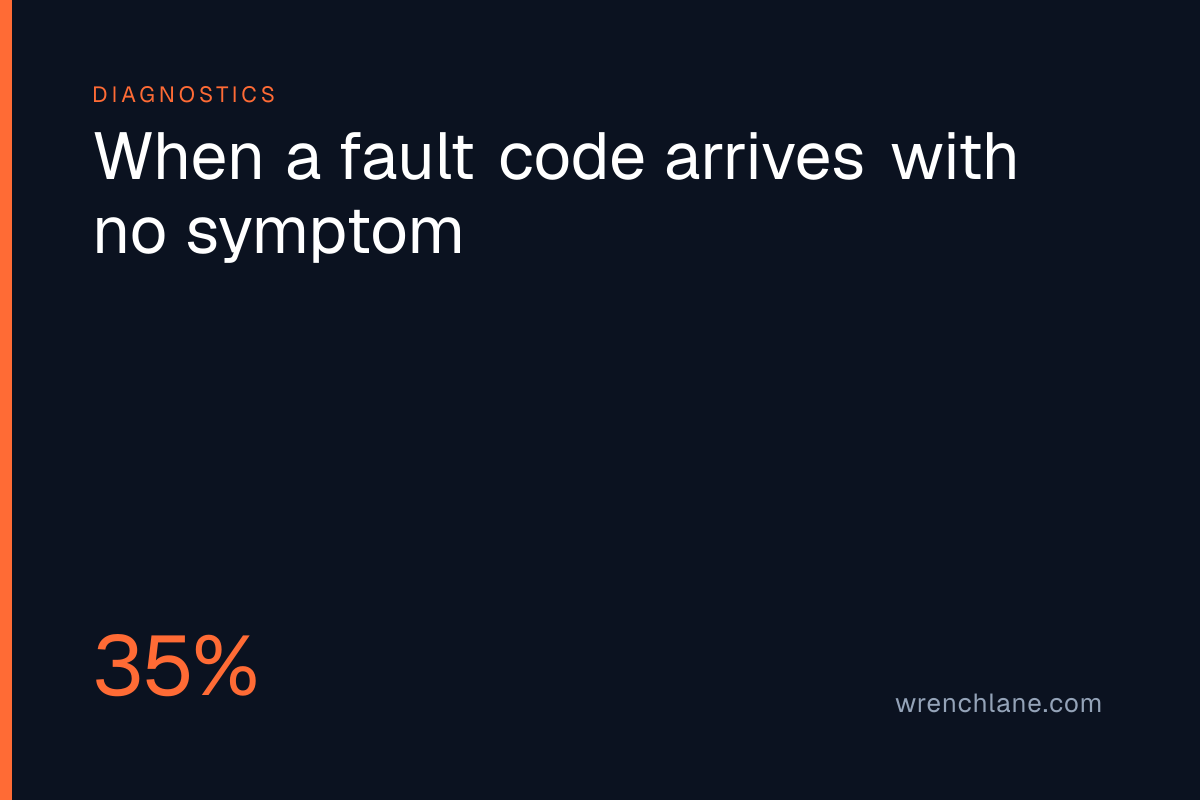
In our diagnostic platform data, 35 percent of jobs containing a fault code are submitted with absolutely no symptom description. A technician enters a bare code like P0016, and the entire diagnostic process has to start from there.
The confidence of a single code
We pulled our own platform data from February 18 to September 3, 2026. Out of 2,879 total diagnostic sessions, 1,573 included at least one readable fault code. Among those coded diagnostics, 557 were submitted as codes only. That means more than a third of these jobs started with zero context about what the vehicle was actually doing in the real world.
The numbers reveal a very specific habit at the bay. When a vehicle presents no codes at all, technicians write a symptom description 93 percent of the time across 1,306 diagnostics. They have to, because there is nothing else to go on. But as soon as a single fault code appears, that description rate drops to 59 percent out of 1,130 jobs. The code feels like the whole answer. The technician pulls a P0202 for an open injector circuit on cylinder 2, assumes the path is clear, and skips typing out the customer complaint.
The codes that need a story
A bare code narrows what any diagnostic process can do. This is especially true for timing and emissions faults. In our data, P0016 points to a crankshaft and camshaft position correlation issue on bank 1 sensor A. Out of 11 times it was submitted, 73 percent arrived with no description. Does the vehicle have a rattle on startup? Is it an extended crank? Does it stall at idle? That missing text dictates whether you are looking at a stretched chain, a bad phaser, or a faulty sensor.
We see the same pattern across other complex faults. P0011 for camshaft position timing over-advanced arrived bare 68 percent of the time across 19 diagnostics. P20EE, indicating SCR NOx catalyst efficiency below threshold, lacked a description 67 percent of the time across 12 jobs. P0647 for an A/C clutch relay control circuit high was submitted without symptoms 86 percent of the time across seven occurrences. P0172, indicating system too rich on bank 1, was bare in 60 percent of 10 diagnostics. Even chassis faults suffer from this. A C0037 for a left rear wheel speed sensor circuit was bare in 60 percent of its five diagnostics. In a busy workshop, typing out the symptoms feels like a luxury when the scanner already gave you a number.
The multi-code breaking point
Interestingly, that confidence disappears when the scanner lights up completely. When a technician pulls two codes, they write a description 78 percent of the time across 222 diagnostics. At three codes, the rate is 68 percent over 103 jobs.
By the time a vehicle presents four to five codes, the technician provides a written description 85 percent of the time over 73 diagnostics. At six or more codes, that figure climbs to 87 percent across 45 jobs. A single code looks like a diagnosis. A massive cascade of six codes looks like an electrical nightmare, and the technician suddenly realizes they need to explain that the dashboard lit up after a heavy rainstorm.
Giving the diagnosis a head start
This is not a criticism of how mechanics work. It is a direct reflection of time pressure in an independent workshop. You need to get the vehicle into the bay, read the data, and move forward. But relying on the code alone cuts off half the diagnostic power you have available.
If you run a workshop, look at how tickets move from the service desk to the bay. Do your technicians get the full story the customer told, or just a printed sheet with a bare fault code?