When you plug a scanner into a Toyota, you have a zero percent chance of seeing a failure-type byte attached to your diagnostic trouble code. We know this because we measure it. Between February 18 and October 9 of 2026, we tracked 3,545 total diagnostic sessions through the diagnostic platform we build. Out of those, 1,953 jobs generated at least one readable fault code.
The data shows a massive gap in how different manufacturers communicate failure. A Volvo will give you a failure-type byte 77 percent of the time. This sub-code specifies exactly how a circuit failed, telling you if a wire is shorted to ground, open, or carrying an implausible signal. When you move to a Peugeot, that vital piece of context drops to just 2 percent. This is the real reason brand experience is difficult to transfer across the workshop floor. Mechanics are not just learning how a vehicle is built. They are learning how that specific brand complains when it breaks.
The failure-type divide
The presence of a failure-type byte completely changes how a technician starts a job. If a code tells you exactly what happened electrically, your first physical check is highly targeted. If a code only names the component, your technician is stuck doing foundational electrical testing just to figure out what kind of fault they are chasing.
Our data reveals a stark regional and brand divide. European luxury and premium brands tend to be highly communicative. After Volvo at 77 percent, Land Rover provides failure bytes 66 percent of the time. Audi sits at 58 percent, Mercedes-Benz at 50 percent, and Volkswagen at 49 percent.
Other brands leave you entirely in the dark. Ford provides a failure-type byte just 8 percent of the time. Nissan sits at 7 percent, and Saab provides them in only 5 percent of coded diagnostics. Toyota sits firmly at the bottom of our dataset at 0 percent. If your shop works heavily on these brands, your technicians have to rely entirely on live data, wiring diagrams, and their own manual probing to fill in the blanks the control modules refuse to supply.
Code density tells a story
Beyond how detailed the codes are, we also see a big difference in how many codes a vehicle throws for a given problem. This is code density. A high code density means the control modules are highly sensitive and quick to report cascade failures, where one bad sensor triggers complaints from three other modules.
Volkswagen leads our dataset with 1.94 codes per job on average across 267 coded diagnostics. BMW follows closely at 1.85 codes per job. Saab averages 1.81 codes, and Volvo sits at 1.83 codes per job. When a technician tackles these vehicles, part of the job is simply filtering out the noise. They have to decide which code is the root cause and which codes are just symptoms of the first failure.
On the other end of the spectrum, Toyota averages a sparse 1.25 codes per job across 72 diagnostics. Peugeot and Skoda both average 1.43 codes per job. A lower code density means less noise to filter, but it also means fewer clues when a complex drivability issue arises.
The signature faults
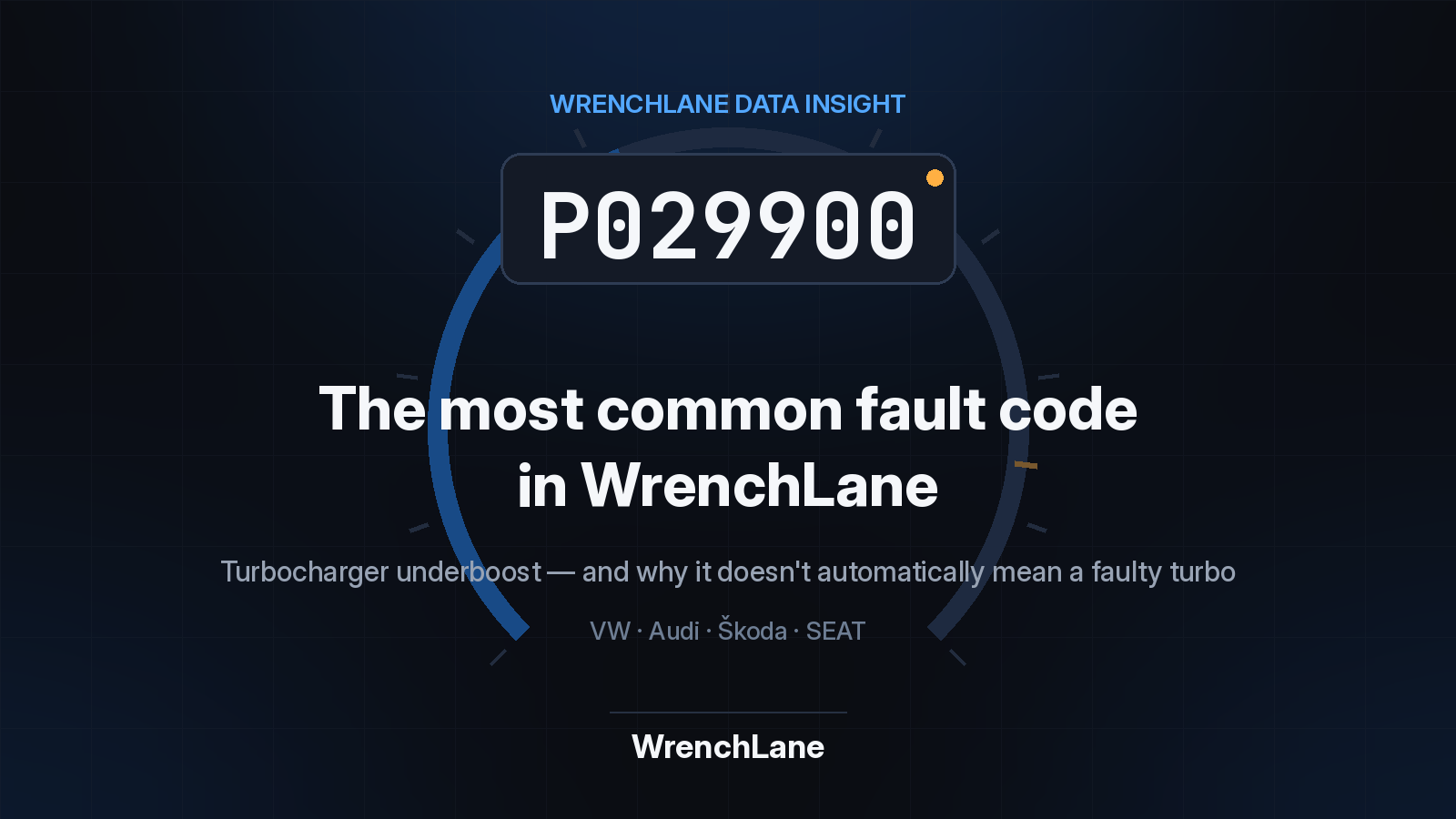
Every brand has a code that haunts independent workshops. We call these signature codes. In our platform data, the P0299 code for a turbocharger underboost condition is incredibly dominant. It is the single most common code for three different manufacturers. It appeared 18 times for Volkswagen, 18 times for Volvo, and 7 times for Skoda. For all three of these brands, the most common fault family is powertrain related.
BMW presents a completely different diagnostic reality. Across 67 coded diagnostics, the signature code for BMW is P0300, indicating a random or multiple cylinder misfire. This code popped up 25 times. The most common fault family for BMW in our system is fuel trim related.
Audi and Land Rover share a different pattern entirely. For Audi, the most common fault family is bus communication, while the single most frequent code is P0562 for low system voltage, showing up 12 times. Land Rover also sees bus communication as its most frequent fault family, while its top single code is P0102 for a mass or volume air flow circuit low input, appearing 9 times.
Other brands are defined by highly specific component failures. Mercedes-Benz sees P0087 for low fuel rail system pressure as its top code. Ford technicians see P2463 for diesel particulate filter restriction 7 times in our window. Saab is dominated by injector issues, specifically P0201 for an open injector circuit on cylinder 1. Toyota sees P0420 for catalyst system efficiency as its top code.
Rethinking multi-brand efficiency
We often expect a good mechanic to fix anything that rolls through the door. But when you look at how wildly different the diagnostic data is from one bay to the next, that expectation looks unreasonable.
A technician moving from an Audi to a Toyota is moving from a vehicle that tells them exactly how an electrical circuit failed, to a vehicle that only gives a vague component name. A mechanic moving from a Toyota to a Volkswagen is moving from a quiet system to a noisy one that requires heavy filtering.
These differences matter. They dictate whether a diagnostic step involves a wiring schematic or a test drive. They dictate whether a job takes twenty minutes to diagnose or two hours.
Do you see this same divide in your own workshop, and how do you handle scheduling when certain brands demand entirely different diagnostic approaches?