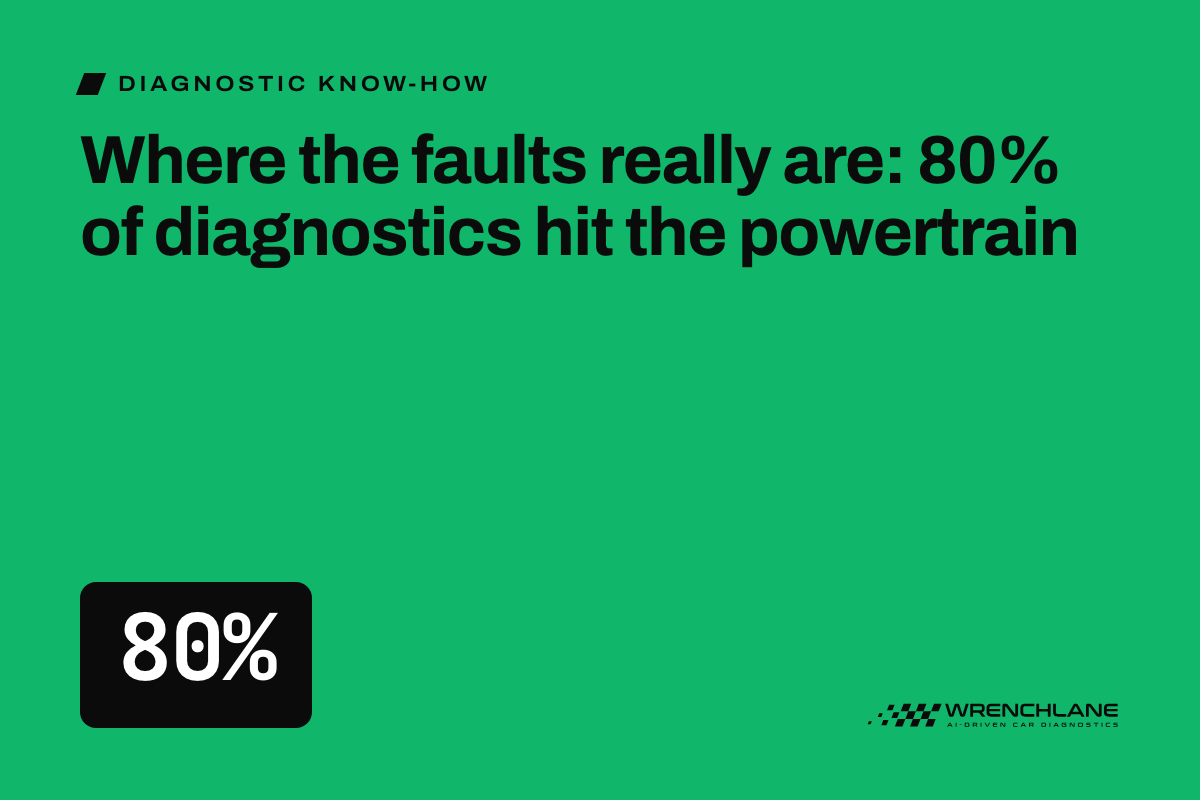
Out of nearly 2,000 coded diagnostics run through our platform, 80% pointed straight to the powertrain.
We looked at 1,969 diagnostics that included at least one readable fault code between February and October 2026. This is our own platform data from independent workshops, not an industry-wide survey. It gives a clear picture of what mechanics are actually fixing right now.
Powertrain dominates the bays
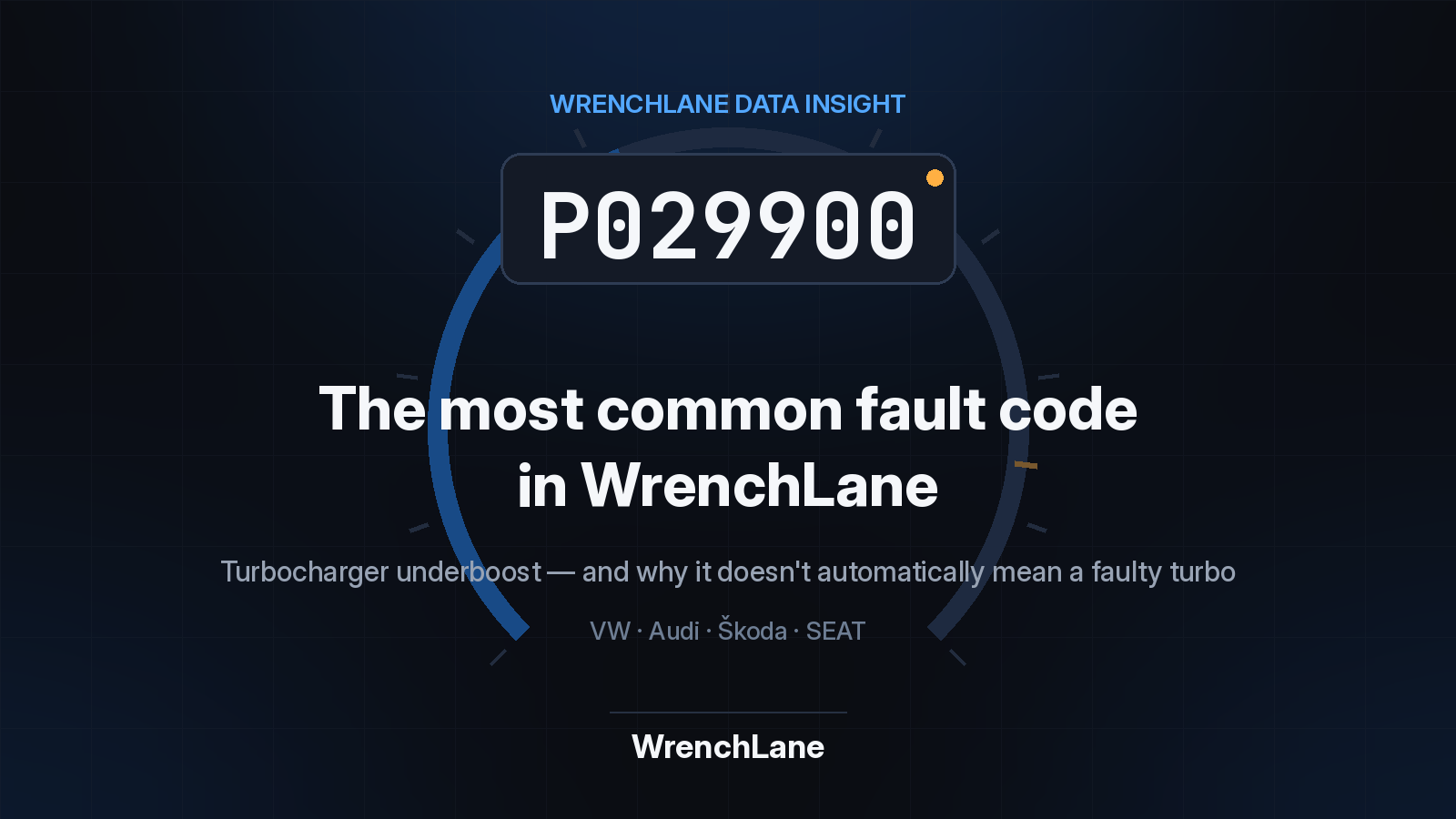
The powertrain category, covering engine, fuel, air, ignition, emissions, and transmission, accounted for 1,568 of those diagnostics. That is 80% of all coded sessions. Across that group, we saw 852 distinct codes. The single most common was P0299, a turbocharger underboost condition, showing up 77 times.
If you want to know where to train your technicians, this is it. Turbo and boost control issues alone drove 187 diagnostics across 32 distinct codes. Valve timing and camshaft faults accounted for 115 diagnostics. Air intake, fuel delivery, and diesel particulate filters each hovered around the 100-diagnostic mark.
The network is often the symptom, not the cause
Network codes appeared in 208 diagnostics, or 11%. The most common was U0100, lost communication with the ECM/PCM. But a communication fault is frequently just a symptom. When a module stops answering on the CAN bus, or sends implausible data, the root cause is often a power or wiring issue rather than a failed module itself.
Body and chassis take a backseat
Body faults, covering interior electronics like restraints, lighting, and climate, accounted for 212 diagnostics (11%). Chassis issues, including ABS, steering, and suspension, were the least common major system at 152 diagnostics (8%).
Interestingly, generic SAE codes still make up 58% of the code instances we see, despite the rise in manufacturer-specific diagnostics.
Are you seeing this same heavy weighting toward powertrain and turbo faults in your own bays?