A flashing red oil pressure warning above 1500 RPM on a 2000 Volkswagen Golf IV can easily lead a technician down the wrong path, especially when mechanical pressure measures a perfectly healthy 4 bar at 3000 RPM. This exact scenario recently came through our diagnostic platform, complete with a frustrating twist. The technician had already replaced the oil pressure switch and performed an oil change, yet the STOP message kept appearing the moment the car drove off.
Dynamic cluster logic hides the electrical fault
The technician hooked up a gauge and confirmed the engine had excellent mechanical pressure. At 90 degrees Celsius, it read 2 bar at 900 RPM and 4 bar at 3000 RPM. The engine was completely safe.
The issue lies in how the instrument cluster processes the oil pressure signal. On this vehicle, the system uses a dynamic logic managed entirely by the processor inside the cluster. Below roughly 1500 to 2000 RPM, the cluster does not monitor the state of the pressure switch at all. Once engine speed crosses that threshold, the cluster checks if the switch has closed the circuit to ground.
If that ground signal is missing, the cluster assumes zero pressure. It immediately triggers the flashing red light, three warning beeps, and the STOP message. Our engine ranked an open electrical circuit or an incompatible aftermarket switch as the 92% probable cause. A new switch with a normally closed design instead of normally open, or a corroded connector pin, will cause exactly this symptom.
The connection between P0401 and P1176
Alongside the oil warning, this 1.4 AXP engine had two fault codes stored: P1176 and P0401. These might look unrelated to each other, but they share a direct mechanical link.
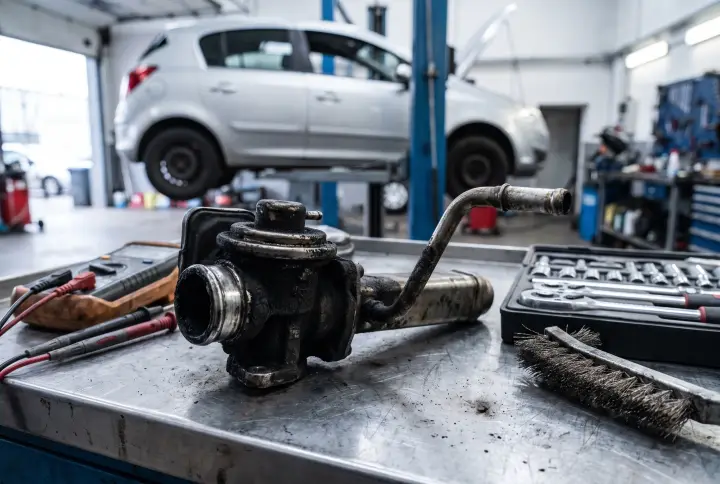
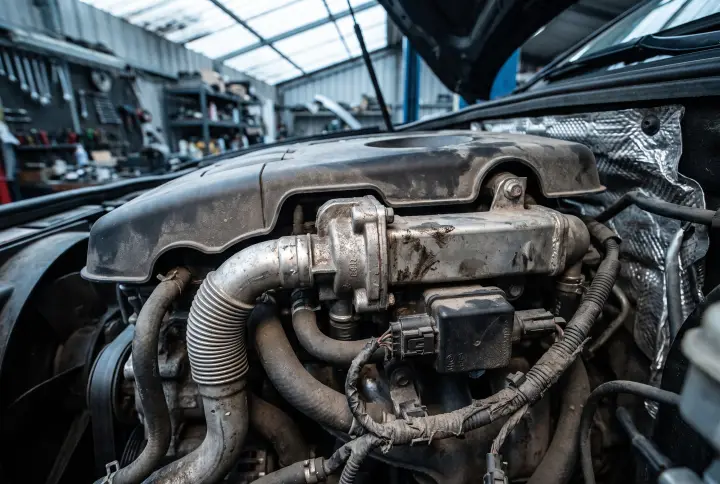
Exhaust gases route from the EGR valve through a metal pipe to a calibrated port in the flange under the throttle body. Crankcase vapors combine with exhaust soot to completely block this port with solid carbon. When the engine control module commands the EGR valve open, it watches the manifold absolute pressure sensor for a specific pressure jump. A blocked port means no pressure jump, logging the P0401 insufficient flow code.
The lack of inert exhaust gas then alters combustion temperatures and dynamics. This forces the secondary fuel trim, monitored by the downstream lambda sensor, to push its adjustment until it hits the absolute limit. At that point, the system triggers P1176.
Ruling out exhaust leaks and stuck valves
Our platform also flagged a cracked flex pipe as a 70% probability for the P1176 code. The flex pipe on the 1.4 AXP engine frequently cracks under continuous engine vibration. Exhaust pulses create a Venturi effect, sucking fresh atmospheric oxygen directly into the exhaust stream. The downstream oxygen sensor reads this stray oxygen as a lean condition, pushing fuel trims to their maximum limit.
A mechanically stuck EGR valve ranked at 65%. Even if the internal motor receives a command, dense carbon can lock the valve spindle shut. If the internal potentiometer track is worn out, the control module never sees the valve move.
What this diagnostic case teaches
When a Golf IV shows an oil pressure warning only above idle, always verify the mechanical pressure first. If the gauge shows healthy pressure, you are chasing an electrical fault. Test the ground signal at the switch connector under load, check continuity to pin 10 on the blue cluster connector, and confirm the replacement switch is the correct normally open type. For the emissions codes, always inspect the EGR port under the throttle body for carbon blockage before condemning the EGR valve itself.
Reference pages for the codes in this article
- P0401: what we measure for this code across real diagnostics