A 1997 Jeep Wrangler recently arrived in a bay with P1398, P0340, and P1391 stored, sputtering and backfiring heavily around 2,000 RPM. Despite a recent replacement of the Camshaft Position Sensor (CMP), distributor cap, rotor, spark plugs, and wires, the 4.0L engine refused to smooth out under load.
Mechanical wear inside the distributor
Our diagnostic platform ranked distributor shaft bushing wear or mechanical mis-indexing as the highest probability fault at 80 percent. On the 4.0L engine, the CMP is a Hall-effect pickup housed directly inside the distributor beneath the rotor. When the distributor shaft bushings wear out, lateral shaft play causes the rotating pulse ring to wobble. Excessive radial play alters the critical sensor air gap dynamically as engine RPM rises, triggering the codes despite the new parts.
If the distributor was reinstalled even one gear tooth off during the recent service, the fuel sync and injector timing window becomes severely misaligned with the crankshaft signal (CKP). The diagnostic path suggests inspecting the distributor shaft for radial side-to-side bushing play with the cap and rotor removed, and verifying static distributor indexing alignment at Cylinder 1 Top Dead Center on the compression stroke.
Crankshaft sensor signal dropouts
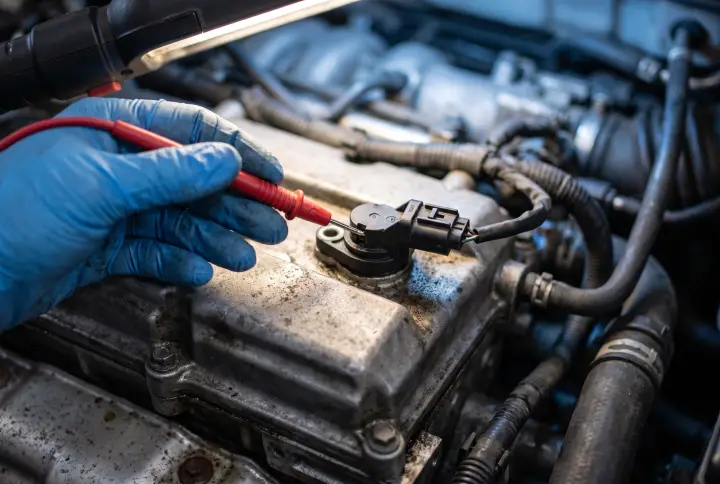
The second most likely cause, ranked at 75 percent, is an internal breakdown or loose mounting of the Crankshaft Position Sensor. The CMP was recently replaced, but the CKP remains in service. DTC P1391 specifically indicates an intermittent signal from either the CMP or CKP, while P1398 shows that the misfire adaptive numerator has reached its calibration limit due to more than a 2.86 percent variation between crankshaft target windows.
Mounted to the transmission bellhousing, the Hall-effect CKP reads slots in the flywheel or flexplate. Thermal breakdown of the internal circuitry, cracked magnets, or loose mounting bolts allow the sensor gap to wander under engine vibration. This causes signal dropouts near 2,000 RPM that trigger backfires. Technicians should inspect the CKP mounting bolts for tightness and perform a dynamic lab scope capture of the CKP signal wire during cranking and at 2,000 RPM.
Wiring chafing behind the cylinder head
Ranked at 60 percent, wiring harness chafing or connector terminal tension loss is another common fault. On these vehicles, the main engine wiring harness drops down along the firewall and wraps tightly behind the rear of the cylinder head to reach the distributor, bellhousing CKP, and oxygen sensors. The harness is prone to chafing against the sharp rear cylinder head casting or exhaust heat shields.
Terminal tension loss inside the 3-pin CMP and CKP pigtail connectors frequently causes momentary opens when the engine torques over under load. This intermittent circuit loss starves the PCM of timing pulses. A visual inspection of the wiring loom behind the cylinder head and a pin-drag tension test on the female connector terminals will confirm this issue.
Timing chain stretch
Excessive timing chain stretch and sprocket wear ranked at 45 percent. Chain slack creates rotational lash between the crankshaft and the camshaft. When engine RPM transitions under load, valvetrain drag causes the camshaft to retard relative to the crankshaft. The PCM detects this phase discrepancy as an intermittent sensor sync loss (P1391). Measuring timing chain rotational slack using a breaker bar on the crankshaft damper while observing distributor rotor movement is the recommended test.
How to begin the diagnosis
Start by checking the distributor for lateral shaft play, as mechanical wear in the housing will defeat any new sensor installed inside it. Verify the static indexing alignment next, especially following recent ignition work, before moving on to scope the crankshaft position sensor under load.
Reference pages for the codes in this article
- P0340: what we measure for this code across real diagnostics