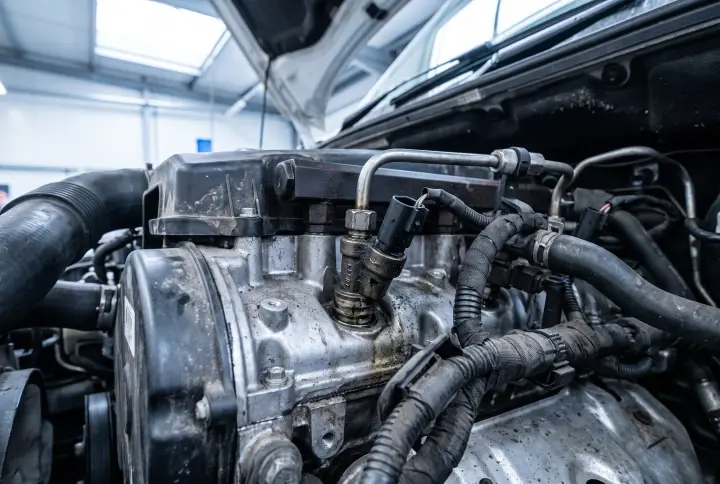
A 2009 Mercedes-Benz E Coupe W207 arrived with the engine management light on and a distinct struggle to start, throwing a single P034062 fault code. The technician noted that the vehicle struggled to start and took a few turns before it could fire up, regardless of temperature. Our diagnostic platform analyzed this combination of code P034062 and the extended crank symptom to map out the most probable root causes in the Mercedes-Benz M271.860 engine.
The Mechanics of Code P034062
The presence of P034062 specifically points to an issue with the intake camshaft. In Mercedes-Benz diagnostic protocol, sub-code 62 designates a signal compare failure. This means the ME-SFI control unit detects that the intake camshaft position sensor signal pulse transition arrives late relative to the crankshaft position 60-2 reference signal during engine cranking.
Because the engine cannot reliably establish cylinder phase synchronization on the initial crank revolutions, the ECU forces the starter motor to crank for several additional revolutions until it confirms phase synchronization or enters a fallback strategy. This directly explains why the vehicle struggles to start on every cycle.
Stretched Timing Chains and Worn Tensioners
Our data ranked a stretched timing chain and worn hydraulic tensioner as the most likely cause, calculating an 82 percent probability with a high severity warning. The 1.8L turbocharged direct-injection CGI engine, designated M271.860, is known for premature timing chain elongation and chain guide wear. Severe chain elongation risks jumping sprocket teeth, which can cause catastrophic valve-to-piston contact.
To confirm this mechanical failure, the diagnostic path requires removing the cylinder head cover to verify camshaft-to-crankshaft timing marks at top dead center. Technicians must measure timing chain elongation and tensioner plunger extension using the specific Mercedes-Benz service procedure. It is also highly effective to monitor the intake camshaft actual versus specified position angles in the ME-SFI live data during cranking.
Adjuster Locking Failures and Camshaft Oscillation
The second most probable cause, ranked at 70 percent, was a failed intake camshaft adjuster internal locking mechanism. The variable valve timing phaser on the M271.860 engine uses an internal spring-loaded locking pin designed to mechanically lock the phaser at its base park position whenever oil pressure decays at engine shutdown.
With age and regular cycling, the internal locking pin and bore wear out or the return spring breaks. The adjuster then fails to lock into base timing at shutdown. During initial engine cranking, before oil gallery pressure reaches 20 to 30 psi, valvetrain torque causes the unlocked camshaft to oscillate back and forth relative to the drive sprocket. This oscillation delays and corrupts the intake camshaft position sensor signal transitions. Testing this involves checking the intake camshaft adjuster for mechanical free play with the valve cover removed, inspecting the sprocket teeth for acute hook wear, and performing a bi-directional actuation test of the intake camshaft variable valve timing solenoid.
Capillary Oil Wicking and Electrical Degradation
Ranked at 58 percent probability was oil contamination in the camshaft sensor harness via solenoid wicking. A documented failure mode on the M271 engine family is oil wicking through the electrical pins of the camshaft adjuster solenoids and position sensors. Internal seals degrade and allow pressurized engine oil to breach the electrical pin cavities. This oil travels via capillary action through the wire strands into the intake camshaft position sensor connector and down the harness toward the ME-SFI control unit.
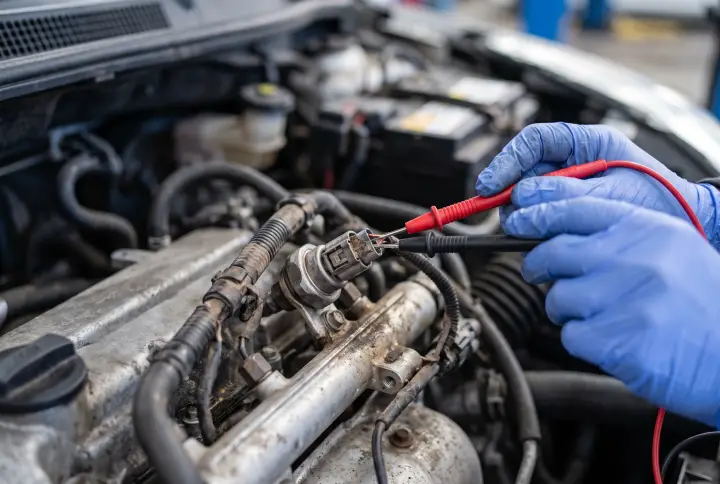
Dirty engine oil contains conductive soot that alters dielectric properties, causing signal attenuation, capacitive edge rounding, and false voltage transitions. The ECU reads an implausible waveform during cranking and flags the compare failure. The necessary checks include disconnecting the intake camshaft position sensor and front adjuster magnet plugs to inspect for oil, checking the ME-SFI engine control module main connectors for oil ingress, and installing sacrificial isolation pigtails if contamination is found.
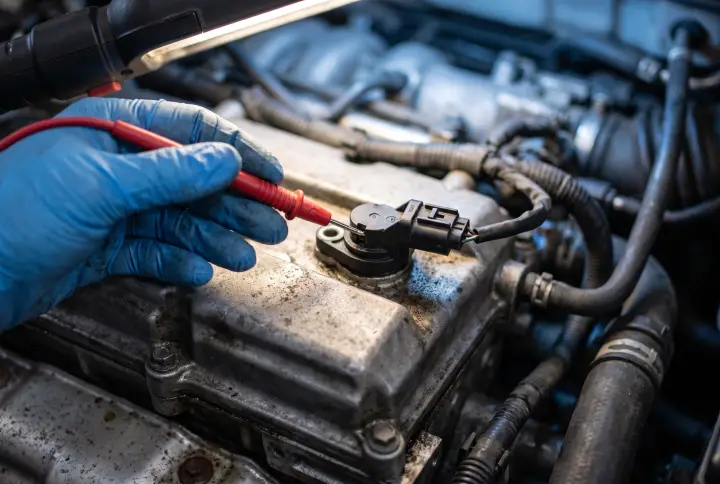
Furthermore, internal electrical degradation of the intake camshaft position sensor itself ranked at 45 percent. The Hall-effect sensor generates a digital square wave, and thermal cycling can degrade the internal components. This decreases signal amplitude at low cranking speeds of 150 to 250 RPM. Scoping the sensor signal wire during cranking to check waveform amplitude and rise times is the definitive way to rule this out.
What to Check First on the M271
When faced with extended cranking and a P034062 code on the M271.860 engine, technicians should start by pulling the connectors at the front camshaft adjuster magnets and sensors to inspect for oil wicking. If the connectors are dry, checking the intake camshaft actual versus specified position angles in live data during cranking provides immediate insight before removing the valve cover to inspect the mechanical timing chain and adjuster lock.
Reference pages for the codes in this article
- P0340: what we measure for this code across real diagnostics