A 2015 Jeep Renegade arrived with a high-voltage system warning on the dash, yet it was a pure combustion 2.4L MultiAir. The diagnostic platform we build analyzed the combination of an EV fault code (P0BFE) and a thermostat code (P0599) to pinpoint either a catastrophic ground loss or capillary coolant migration.
The technician noted that the vehicle displayed warnings about the high voltage system and could not be driven. Seeing an electric drive motor fault on a traditional gasoline engine points directly to a major network or module failure, rather than a genuine component issue.
Phantom Codes from a Missing Ground
Code P0BFE indicates a correlation issue with Drive Motor B Phase Current Sensor. The Jeep Renegade 2.4L MultiAir is a pure combustion vehicle without an electric motor or high-voltage battery. Our data ranked a main ground fault or break on the engine and chassis ground connections (G101 or G102) at an 80 percent probability.
When the powertrain control module (PCM) loses its ground potential, the reference voltages float. This immediately shuts down ignition and injection. The resulting imbalance on the CAN bus causes the instrument cluster and body control module (BCM) to misinterpret data frames. They subsequently activate warning messages and phantom codes that actually belong to hybrid platforms sharing the same general software architecture.
The Thermostat Connection
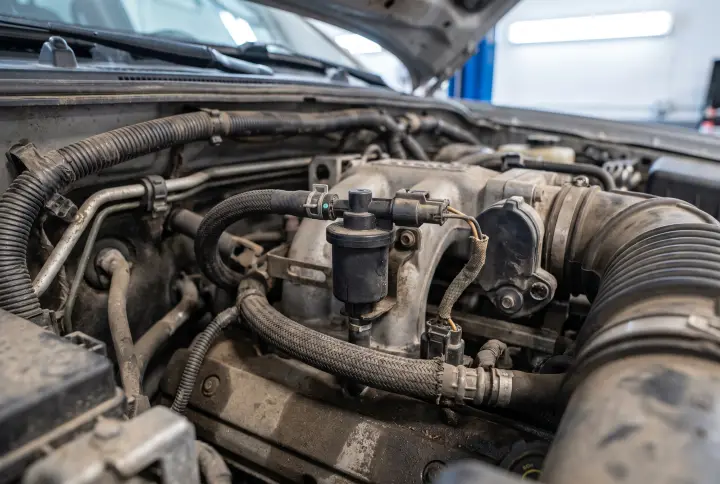
The second fault code present was P0599, pointing to a Thermostat Heater Control Circuit High condition. On the 2.4L MultiAir engine, the thermostat opening is actively managed via an internal pulse-width modulated (PWM) heating element.
Our system ranked a defective electronic thermostat unit as the highest probability cause at 85 percent. When the internal heating coil burns out and shorts, or if the internal seal fails and allows pressurized coolant into the two-pin connector, the circuit resistance drops toward zero ohms. This creates a direct short to 12 volts, immediately triggering the P0599 code in the PCM.
The Threat of Coolant Migration
The physical failure at the thermostat introduces a severe secondary risk. The platform identified coolant migration from the thermostat to the PCM connector as a high-severity cause, ranked at 70 percent.
When the internal gasket in the thermostat housing fails, hot coolant under 1 to 1.5 bar of pressure is forced into the electrical connector. Capillary action then pulls this fluid inside the copper wire strands all the way through the engine harness to the main PCM connector. The electrically conductive glycol shorts adjacent pins upon arrival. This scenario bridges the two distinct symptoms, causing the engine stall, distorting the sensor references to generate the P0BFE code, and setting the P0599 code from the original short.
Software and Tool Conflicts
We also ranked a software conflict at 65 percent. Because P0BFE has no physical application on this engine, the network might be experiencing a corrupt PCM calibration or a lost Proxi configuration in the BCM, making the vehicle think it has a hybrid drivetrain. Alternatively, a universal diagnostic tool could simply be misinterpreting a proprietary FCA manufacturer code as the generic EOBD code P0BFE.
Diagnostic Next Steps
When a conventional combustion vehicle presents with high-voltage system warnings and phantom EV codes, verify the integrity of the network before replacing any sensors. Start by removing and inspecting the two main PCM connectors for moisture or glycol residue, which would confirm capillary coolant migration. If the pins are dry, move immediately to a voltage drop test between the engine block and the negative battery terminal during a starting attempt to rule out a broken G101 or G102 ground.