A 2012 SEAT Mii rolled into the workshop with the MIL illuminated, absolutely no power, and a cluster of throttle position codes including P0122, P0222, P022200, P211900, U101F00, and P012200. The technician reported complete power loss, matching the failsafe behavior expected when engine control modules lose throttle position feedback.
Our diagnostic platform analyzed the combination of low-voltage codes and range performance codes, breaking down the root causes for this specific CHYA 1.0-liter 3-cylinder MPI engine.
The 5V Reference Circuit
An open or short circuit in the 5V reference voltage ranked highest at 65 percent probability. On this engine, the two potentiometers inside the throttle body (G187 and G188) share a 5V supply on Pin 5 and a sensor ground on Pin 3 from the ECU.
If the wiring harness suffers a break, rodent damage, or shorts to ground against the intake manifold, the supply voltage for both sensor tracks drops synchronously. Once the signal voltage falls below the 0.20V threshold, the ECU logs P0122 and P0222. Unable to verify throttle position, the ECU shuts down the throttle actuator for safety. The internal spring pulls the flap back to a mechanical default of 6 to 7 degrees, generating the P211900 range/performance code and causing the massive power loss.
Testing starts with verifying the 5V supply at Pin 5 against the ground at Pin 3 with the ignition on, followed by checking resistance on signal lines Pin 4 and Pin 6.
Internal Throttle Body Failure
An internal defect of the throttle body unit (GX3) ranked second at 55 percent probability. The unit is sealed, containing the actuator motor (G186), gearing, and two redundant slider tracks.
Internal component failures like broken contact springs, worn tracks, or an internal short to the housing ground will drop both sensor signals to 0V. Furthermore, if internal plastic gears strip or the return spring breaks, the motor cannot mechanically position the flap. The ECU detects this regulation deviation and sets P211900.
Diagnostics here require resistance measurements of the potentiometer tracks directly at the throttle body pins, followed by checking the opposing signal curves while manually moving the flap.
Connector Issues and Carbon Buildup
Pin Corrosion and Tension
Ranked at 40 percent probability, the 6-pin connector at the throttle body is vulnerable to engine vibration and moisture. Water ingress or improper uncoupling can lead to green corrosion or expanded female pins. High resistance at Pin 5 or Pin 3 drops the operating voltage below the ECU's 0.20V recognition threshold. Technicians need to inspect for moisture and perform a pin drag test to confirm contact tension.
Mechanical Binding
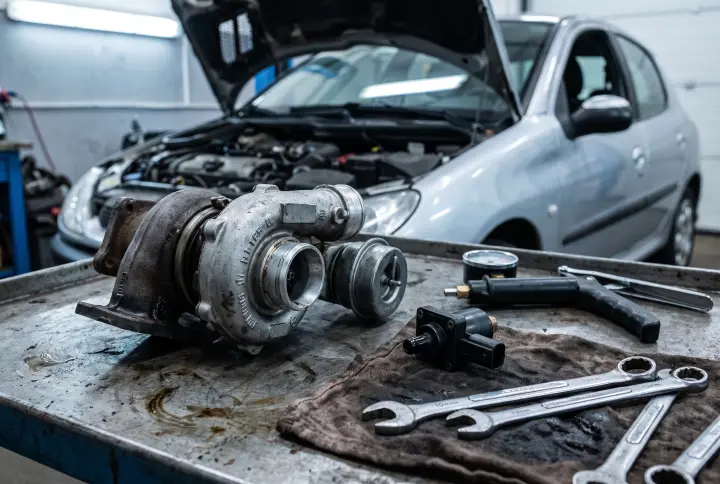
Mechanical binding or coking of the throttle body ranked at 25 percent probability. Because crankcase ventilation routes upstream of the throttle body on the 1.0 MPI, soot and oil vapors can coat the bore over time. If carbon buildup prevents the flap from reaching its commanded position, it triggers P211900. Removing the intake hose for a visual inspection and manual flap test confirms this condition.
Where to Start
Before condemning the expensive throttle body assembly, begin at the 6-pin connector. Confirm contact tension with a drag test and verify the 5V reference and ground are present with the ignition on. If the supply is missing, trace the harness back to the ECU to locate the break or short.