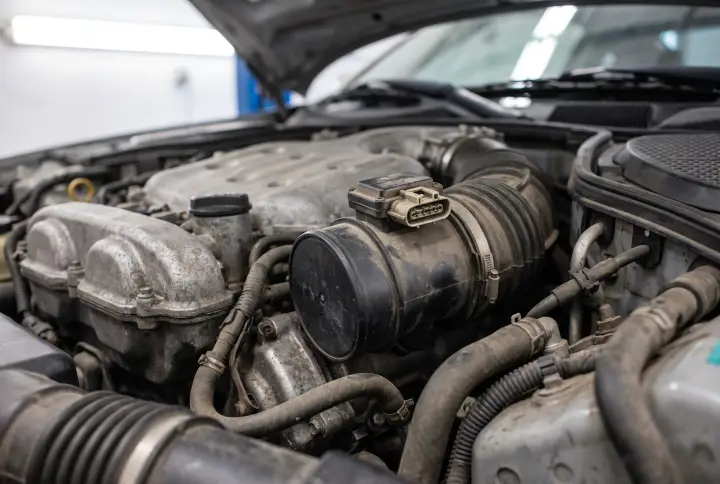
A 2019 Mercedes Vito rolls into the bay with an intermittent check engine light, but the driver reports the van drives perfectly fine. The vehicle, located in the Swedish market, had stored fault code P300947. The technician noted the symptom verbatim: the car runs well and the engine light comes on sometimes, but drivability feels completely normal.
Code P300947 on the OM654 engine indicates a deviation in fuel and air regulation under load. When a van drives perfectly under steady throttle but occasionally triggers this code, the diagnostic path must look at what happens when the system is briefly stressed.
The charge air system under load
Our diagnostic platform ranked a leak in the charge air system as the most likely cause, calculating a 78 percent probability. A micro-crack in a charge air hose or the intercooler is a frequent culprit here.
Under calm driving and steady throttle, a small crack seals tight and the engine functions normally. When the driver accelerates, boost pressure rises, the hose expands, and pressurized air escapes. This creates a brief discrepancy between the calculated and measured air mass, triggering the engine light without forcing the vehicle into a permanent limp mode. To confirm this, the workshop should perform a smoke test of the charge air system, log the target versus actual boost pressure during a road test, and physically inspect the hoses.
Low-pressure fuel restrictions
Ranked closely behind at 72 percent was a clogged fuel filter or restricted low-pressure fuel supply. Under full acceleration, the fuel system of the OM654 requires maximum volume flow.
A partial restriction on the low-pressure side causes a momentary pressure drop right when the high-pressure pump attempts to build maximum rail pressure. The control unit detects an instantaneous shortfall in fuel delivery relative to the air mass and sets P300947. Once the load decreases, pressure normalizes and the van continues to run flawlessly. Testing requires measuring the fuel pressure on the low-pressure side before the high-pressure pump during acceleration, alongside checking the service history for the fuel filter.
Sensor drift and mechanical wear
Contaminated MAF or MAP sensors ranked third at 65 percent. Oil mist from the crankcase ventilation or fine dust can coat the sensor element, leading to thermal lag. The sensor simply cannot react fast enough during rapid transient airflow increases, feeding the control unit an incorrect signal.
Mechanical wear in the quantity or rail pressure control valve followed at 58 percent. During rapid acceleration, the valve must regulate rail pressure between 300 and over 2,200 bar instantly. If the valve binds for a fraction of a second, a momentary regulation deviation occurs. Technicians can check this by logging requested versus actual rail pressure under wide-open throttle and measuring the resistance of the valve coils.
Where to start the diagnosis
Start with the air side. Hook up a smoke machine to the charge air system and look for minor leaks that only open under pressure. If the visual and smoke checks pass, take the van on a road test to log target versus actual boost pressure before spending time testing the low-pressure fuel delivery.