A 2018 Mercedes X-Class arrived in the bay with an illuminated check engine light and a single fault code: P30000D for a hot film mass air flow sensor malfunction. The technician noted the code and warning light, which points immediately to the mass air flow system on the 3.0 V6 CDI (OM642.889) engine.
To map out the most efficient diagnostic path, we processed this specific vehicle and fault code through our diagnostic platform. Our data ranked four distinct causes for this condition, highlighting that a direct sensor code does not always mean a failed component.
Sensor Aging and Calibration Drift
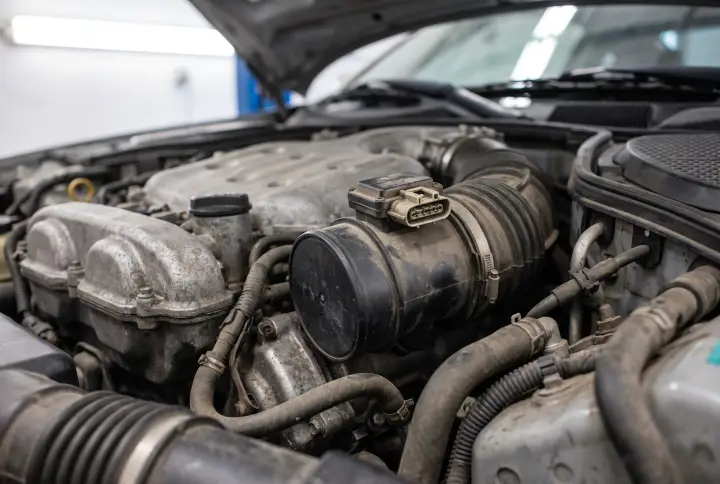
Our platform ranked a defective or aged mass air flow sensor element as the most likely cause, showing a 78 percent probability. The engine control unit continuously calculates the expected air mass based on manifold absolute pressure, engine speed, and exhaust gas recirculation valve position. Over time, the hot film inside the sensor suffers from thermal aging and calibration drift. When the sensor signal falls outside the allowable tolerances compared to the calculated air mass, the P30000D code sets.
The suggested diagnostic steps begin with measuring the reference voltage and ground supply at the sensor connector. Next, read live data to compare actual versus specified air mass at idle, and again between 2500 and 3000 rpm. If the sensor requires replacement, you must reset the adaptation values in the engine control module.
Oil Contamination from the PCV System
Ranked second at 70 percent probability is oil contamination. On the OM642 engine, the positive crankcase ventilation connection sits in the intake tract right in front of the compressor inlet. Oil mist and carbon can accumulate in this area. Pulsations in the intake can push oil droplets backward, coating the hot measuring film inside the sensor.
An oil film acts as a thermal barrier. It delays the cooling of the measuring element, causing the engine control unit to register an unreasonably low or delayed airflow. Oil can also wick via capillary action into the connector, causing electrical tracking. A visual inspection of the measuring element using a good light source is required, along with an inspection of the connector pins for oil intrusion. If contaminated, clean the element with an approved sensor cleaner.
Unmetered Air at the Turbo Inlet
At a 65 percent probability, a mechanical air leak at the turbocharger inlet is a frequent culprit. The central inlet pipe, often called the batwing, connects to the turbocharger compressor housing using a rubber gasket. This is the familiar orange or black inlet seal.
This seal is notorious for wearing out, hardening from heat and oil exposure, or getting pinched improperly during routine service. The plastic flange on the inlet pipe can also crack near the hose clamp. Any of these failures allow the turbocharger to draw in unmetered air downstream of the mass air flow sensor. The control module detects the imbalance between the measured air mass and the requested boost pressure, triggering the same P30000D fault code. Visual removal and inspection of the inlet seal is essential, followed by a smoke test of the intake tract upstream of the turbocharger.
Turbulent Airflow from Deformed Filters
Ranked fourth at 52 percent probability is an issue with the engine air filters. The Mercedes X-Class with the OM642 engine uses two separate air filter cassettes, one on each side of the engine bay.
If these filters are heavily clogged with dirt, damaged by moisture, or have deformed pleats, they create an asymmetrical and turbulent airflow across the measuring grid in the sensor. This flow disturbance alters the cooling profile over the hot film, feeding incorrect dynamic readings to the control module and setting the plausibility code. Technicians should visually verify the cleanliness and shape of both filter inserts, and ensure the filter lids are mounted correctly against their sealing surfaces.
Where to Start the Diagnosis
This case teaches us that a direct sensor fault code on the OM642 engine requires checking the surrounding mechanical environment before ordering parts. Start by inspecting both air filter housings for deformed pleats and verifying the condition of the turbo inlet seal. Pull the connector on the sensor to check for oil wicking from the crankcase ventilation system. If the plumbing is completely sealed and oil-free, live data testing of the sensor will confirm if thermal aging has caused the component to fail.