A 2012 Buick Enclave arrived with a P0171 fault code and elevated fuel trims that refused to drop. The technician had already replaced a bad EVAP purge valve, but the live data showed the engine was still running lean. While the purge valve was a necessary repair, this specific engine architecture frequently masks secondary unmetered air sources that keep Long Term Fuel Trims (LTFT) at positive thresholds.
Our diagnostic platform analyzed the specific vehicle and symptom sequence, ranking a PCV foul air tube vacuum leak as the most probable cause at 82 percent likelihood.
The PCV Foul Air Tube Leak
On the GM 3.6L High Feature V6 (LLT), the positive crankcase ventilation foul air tube connects the rear camshaft cover on Bank 1 to the intake manifold plenum. The quick-connect fittings, O-rings, and nylon tubing are highly susceptible to cracking and splitting. GM Technical Service Bulletins 10160986 and 10129098, along with Engineering Information EI-4081898, document how these components fail to seal against the intake manifold port.
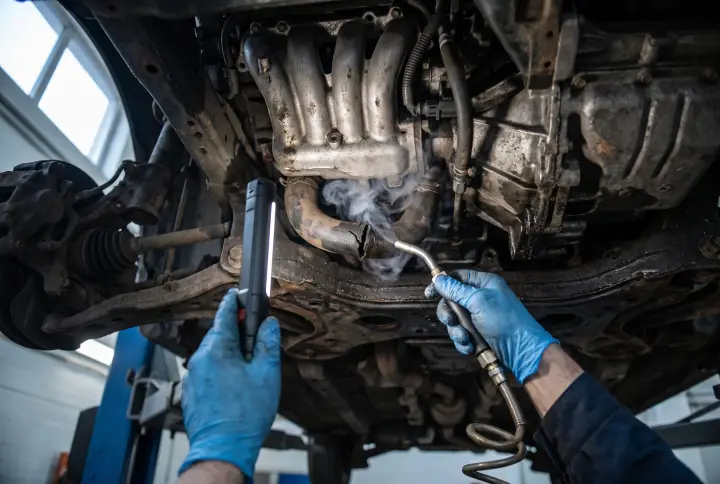
Because this leak enters directly into the central plenum runner tract downstream of the throttle body, it draws unmetered air into both cylinder banks simultaneously. This drives LTFT on Bank 1 and Bank 2 to positive thresholds between 15 and 25 percent. Replacing the EVAP purge valve leaves this shared vacuum leak completely unaddressed. The most direct verification method is monitoring live scan tool fuel trims while manually capping the intake manifold foul air port, followed by a smoke test through the PCV vacuum tract.
Contaminated Mass Air Flow Sensor
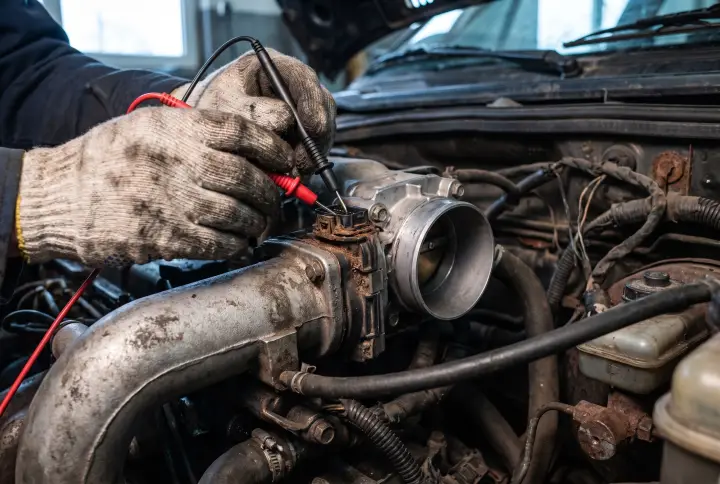
The platform ranked a contaminated Mass Air Flow (MAF) sensor as the next most likely culprit at 76 percent. The MAF sensor calculates the volume and density of incoming air. On the 3.6L LLT engine, oil vapors from the crankcase fresh-air make-up line frequently backflow into the intake duct during engine shutdown. This backflow coats the fine heated sensing elements with a film of oil and airborne dust.
This thermal insulation causes the hot wire to cool more slowly, leading the ECM to under-report the true air mass. As a result, the ECM injects insufficient fuel across the entire RPM range. Unlike a standard vacuum leak, a fouled MAF sensor typically maintains elevated fuel trims at cruise and higher RPM rather than normalizing. A visual inspection of the hot wire elements with a mirror, alongside a calculated load versus actual airflow comparison at 2,500 RPM, will confirm this condition.
Degraded Intake Duct Boots
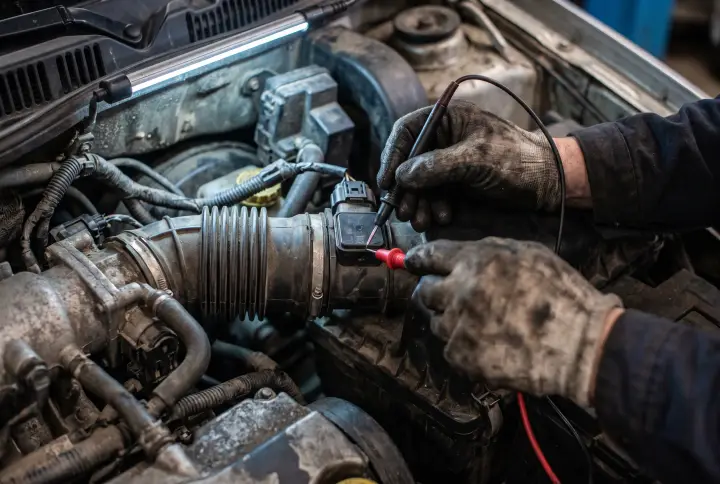
Ranked at 70 percent, the molded rubber and plastic intake duct connecting the MAF sensor housing to the electronic throttle body is another common failure point. On Enclave models that have accumulated significant wear, the flexible accordion pleats degrade from repeated heat cycling and physical engine movement.
Tears typically develop on the underside or hidden between the accordion ribs. This allows unmetered air to bypass the MAF sensor and enter the throttle body plenum directly, driving fuel trims high on both banks. Physical movement of the engine under load opens these splits wider, actively skewing fuel mixture control. Misting water or shop air around the duct pleats while monitoring short-term fuel trim is an effective way to pinpoint these hidden tears.
Flattened Upper Intake Manifold Gaskets
The upper intake manifold plenum seals against the cylinder head intake runners using molded rubber-in-plastic carrier gaskets. After around 176,000 miles and countless heat cycles, these elastomeric seals lose their elasticity, compress, and flatten.
Under maximum intake manifold vacuum at idle, which ranges from 18 to 22 inHg, outside air is drawn past the mating flange directly into the intake ports. When the throttle blade opens at 2,500 RPM, the intake manifold vacuum drops significantly, rendering the leak negligible and allowing fuel trims to drop toward normal. This RPM-dependent trim behavior is the classic signature of a manifold gasket failure. Verification requires checking the plenum bolt torque against the factory specification of 89 lb-in (10 Nm) or running a smoke machine test directly into a manifold vacuum port.
What to Check First
When replacing an EVAP purge valve fails to clear a lean code on the 3.6L LLT, do not assume the replacement part is faulty. Disconnect and cap the PCV foul air port at the intake manifold while watching live fuel trims. If the trims immediately drop, the nylon tubing or quick-connect fittings are compromised. If trims remain elevated across the RPM range, pull the intake duct to inspect the MAF sensor elements and the underside of the accordion boot.
Reference pages for the codes in this article
- P0171: what we measure for this code across real diagnostics