Toyota fault codes
58 distinct codes across 69 real diagnostics on Toyota, including the Toyota-specific ones no generic code list can decode.
Our diagnosis data
Toyota in our diagnoses
35 real diagnoses of a Toyota with at least one standard code, from 26 workshops (February 2026 to November 2026). Which codes came in most, and which cause WrenchLane ranked first.
Standard codes on Toyota, share of these diagnoses
Ranked first on Toyota, by part
These are the causes WrenchLane ranked first, not confirmed repairs, and they describe what independent workshops brought to us, not how reliable Toyota is. Anonymised; our test accounts, the demo car and repeat runs are left out. A figure needs at least 10 diagnoses from 3 or more workshops, a listed code at least 3. Data as of 2026-11-17. How we use diagnosis data
Toyota-specific codes
These are manufacturer-specific, which means the same code on another marque is a different fault. That is exactly why they have no page of their own here and no entry in any generic code list: a single description for one of these would be wrong more often than right. Below they are scoped to Toyota, ranked by how often we have actually seen them, which is a claim we can stand behind.
| Code | Diagnostics on Toyota |
|---|---|
| B1003 | 3 |
| C1201 | 2 |
| C1377 | 2 |
| P1443 | 2 |
| P1578 | 2 |
| P1A50 | 2 |
| B1326 | 1 |
| B132A | 1 |
| B1507 | 1 |
| B1782 | 1 |
| C1204 | 1 |
| C1298 | 1 |
| C1336 | 1 |
| C1419 | 1 |
| P1032 | 1 |
| P1047 | 1 |
| P1345 | 1 |
| P1346 | 1 |
| P1442 | 1 |
| P1604 | 1 |
| P1605 | 1 |
| U1F00 | 1 |
To turn one of these into a cause you need the marque, the model and the engine, which is what the tool does. A code on its own is a starting point, not an answer.
Standard codes we see most on Toyota
These are standardised, so they mean the same thing on every vehicle and each one has a page of its own. The counts are what we see on Toyota specifically.
| Code | What it is | On Toyota |
|---|---|---|
| P0420 | Catalyst system efficiency below threshold, bank 1 | 4 |
| P0335 | Crankshaft position sensor A circuit | 3 |
| P0505 | Idle air control system | 3 |
| B2226 | Not individually documented | 2 |
| B2227 | Not individually documented | 2 |
| B2251 | Not individually documented | 2 |
| P0016 | Crankshaft/camshaft position correlation, bank 1 sensor A | 2 |
| P0031 | O2 sensor heater control circuit low, bank 1 sensor 1 | 2 |
| P0037 | O2 sensor heater control circuit low, bank 1 sensor 2 | 2 |
| P0113 | Intake air temperature sensor 1 circuit high | 2 |
| P0138 | O2 sensor circuit high voltage, bank 1 sensor 2 | 2 |
| P0350 | Ignition coil primary/secondary circuit | 2 |
| P0400 | Exhaust gas recirculation flow | 2 |
| P0430 | Catalyst system efficiency below threshold, bank 2 | 2 |
| P0A0F | Engine failed to start | 2 |
| P20EE | SCR NOx catalyst efficiency below threshold, bank 1 | 2 |
| P220E | Not individually documented | 2 |
| U011B | Not individually documented | 2 |
| P0051 | O2 sensor heater control circuit low, bank 2 sensor 1 | 1 |
| P0087 | Fuel rail/system pressure too low | 1 |
| P008A | Low pressure fuel system pressure too low | 1 |
| P0093 | Fuel system leak detected, large leak | 1 |
| P00BA | Not individually documented | 1 |
| P0100 | Mass or volume air flow circuit | 1 |
| P0136 | O2 sensor circuit, bank 1 sensor 2 | 1 |
| P0141 | O2 sensor heater circuit, bank 1 sensor 2 | 1 |
| P0154 | O2 sensor circuit no activity detected, bank 2 sensor 1 | 1 |
| P0191 | Fuel rail pressure sensor circuit range/performance | 1 |
| P203F | Not individually documented | 1 |
| P2291 | Not individually documented | 1 |
| P2299 | Brake pedal and accelerator pedal position incompatible | 1 |
| P2566 | Turbocharger boost control position sensor circuit high | 1 |
What tends to go wrong on Toyota
By share of the codes we have seen on this marque. A description of our own caseload, not a reliability ranking.
- Body, manufacturer-specific · 13
- Powertrain, manufacturer-specific · 13
- Lambda and O2 sensors · 8
- Chassis, manufacturer-specific · 8
- Catalytic converter · 6
- Valve timing and camshaft · 5
Real cases
Real Toyota cases
Single diagnoses on this make, written up: the car, the codes, the causes ranked and what to check first.
-
Diagnosing Multiple Transmission Slip Codes on a 2019 Camry
-
Diagnosing a P061D No-Start on a 2024 Toyota 4Runner V
-
Diagnosing P2008 on a 2006 Toyota Avensis II
-
Toyota Verso P1604 and P1605: When a Transmission Warning is an Electrical Fault
-
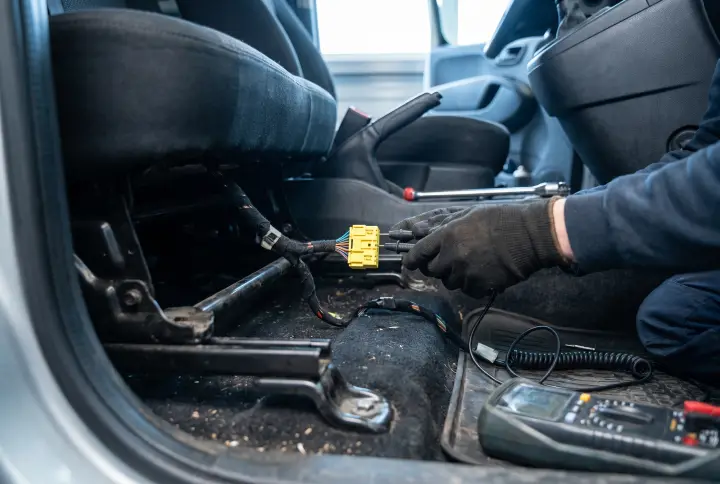
Diagnosing B1003 on a Toyota Proace City Verso After a Seat Swap
-
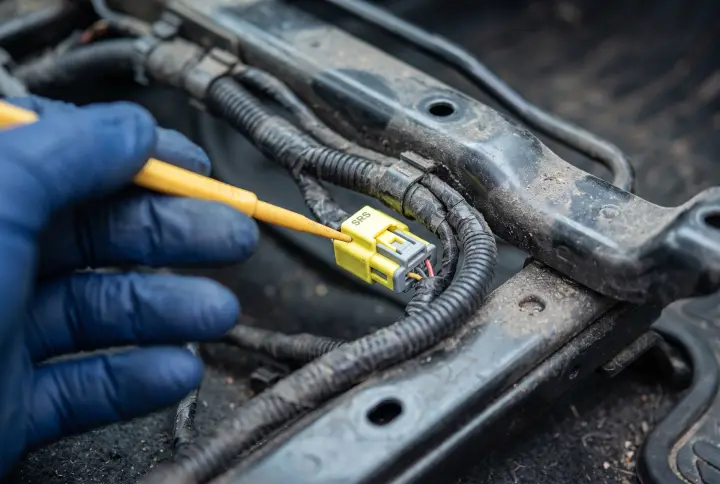
Diagnosing B0020 and U1F00 on a Toyota ProAce City Verso
FAQ
Frequently asked questions
How do I run a diagnosis?
Select the vehicle on Start, click the Diagnostic card and choose New diagnostic. Fill in the description, the error codes and the mileage, then click Analyze.
Do I have to type the codes from my scan tool?
No. Click the camera button next to Error codes and take or choose a photo of the scan tool's screen; WrenchLane reads the codes and their descriptions into the form. You can also speak them with the microphone.
Are the public fault code pages built from my diagnostics?
They use diagnostics run in WrenchLane, with no workshop, customer, registration number or VIN shown. Each fault code page shows how often the code was seen and in how many workshops.
Decode a Toyota code against the actual car
Enter the code, the model and the symptoms and get ranked probable causes for that specific vehicle, with the checks in the order worth doing them.