A 1998 Volkswagen New Beetle arrived with a rough idle on cold starts, occasional power loss, and a cluster of codes including P0300, P0171, and P0128. The technician noted the check engine light was on, with the rough idle specifically happening before the engine warmed up.
Thermostat Failure and Cold Start Misfires
The highest probability cause, ranked at 85 percent by our platform, was a coolant thermostat stuck in the open position. Code P0128 directly points to the engine failing to reach optimal coolant temperature, usually staying below 80 degrees Celsius in the required timeframe.
On the 1.9 TDI ALH engine, running cold forces the control unit to constantly correct the starting dose and modify the injection timing. This leads to poor fuel atomization and unstable cold combustion. The ECU registers this via generic OBD2 as a P0300 misfire or P0171 lean condition. The first recommended test is monitoring the temperature in the engine control unit measuring blocks (group 007) during warmup, along with checking the lower radiator hose temperature before the engine hits 85 degrees.
Sensor Drift Masking as Fuel Issues
Ranked closely at 75 percent was a failure of the G62 coolant temperature sensor. The 1.9 TDI ALH uses a dual 4-pin G62 and G2 sensor, sending separate signals to the engine control unit and the instrument cluster. If the NTC resistor in the G62 section fails, it can underreport the temperature.
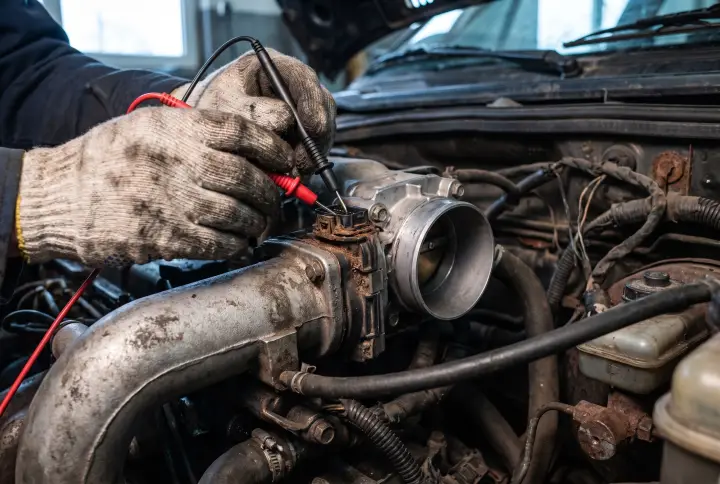
The control unit then misinterprets the warmup time to trigger P0128, delivers an inadequate fuel dose, and incorrectly calculates glow plug heating time. This creates the cold running issues causing P0300 and P0171. A quick diagnostic step here is comparing the G62 engine reading with the G2 cluster reading after an overnight cold soak, followed by measuring resistance across pins 1 and 3 against ambient temperature.
Air Intrusion in the Fuel Supply
At a 70 percent probability, air entering the fuel system ranked as a high severity potential cause. With the Bosch VP37 distributor injection pump on this engine, leaks typically occur at the fuel filter return valve or quick connectors. This draws false air into the fuel, filling the pump and injectors with bubbles.
On cold starts, this drastically reduces the effective injection quantity per cylinder, triggering the P0300 and P0171 codes. Technicians can check this by visually inspecting the clear fuel line for bubbles while the engine is running, or performing a pressure or vacuum test on the injection pump supply.
Mass Air Flow Degradation
The final major cause ranked at 65 percent was an underreporting mass air flow sensor, known as G70. The measuring element in the 1.9 TDI ALH MAF degrades over time, causing it to read less air than is actually entering. The J248 control unit then limits the fuel dose based on the smoke limiter map. This creates the occasional power loss the technician reported, while setting a P0171 or P0300. The definitive test is running a dynamic log of measuring block 003 under full load at 3000 RPM to compare specified versus actual MAF values.
Prioritising the Cold Start Data
When facing this combination of codes on a 1.9 TDI ALH, the temperature fault P0128 is the anchor for the diagnostic path. Always verify the thermostat operation and G62 sensor readings first. Fixing the cooling system will often resolve the injection timing and fuel atomization issues, clearing the misfire and lean codes without requiring invasive fuel system repairs.