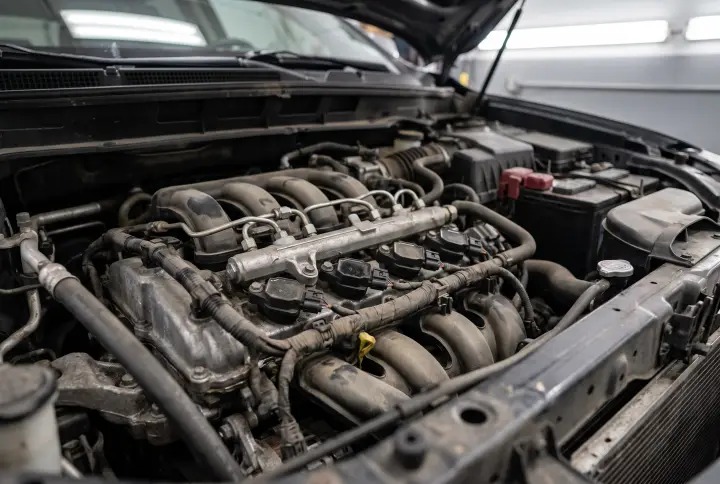
A 2007 Porsche Cayenne arrived with rough idling in gear and a cloud of greyish-blue smoke, bringing nine different fault codes along for the ride. The technician noted that the powertrain oscillations were most noticeable when the vehicle was stopped with the transmission in 'D'. The diagnostic scanner revealed a complex list of codes: P0305, P0306, P0300, P1352, P1377, P1378, P2181, P1559, and P1001.
Tracing the VarioCam Plus Faults
Our diagnostic platform ranked a failure in the VarioCam Plus system on Bank 2 as the highest probability cause, at 85 percent. The presence of P1352, P1377, and P1378 points directly to a problem with the intake valve lift switching on cylinders 6, 7, and 8.
If the hydraulic solenoid valve sticks, or if there is a drop in oil pressure within the Bank 2 cylinder head, the valves remain at a different lift than the engine control unit requests. This creates a severe cylinder filling imbalance, directly causing the heavy idle vibrations under load and triggering the active misfires on cylinders 5 and 6. The recommended approach is to activate the VarioCam Plus solenoid using a diagnostic tester at idle, verify the oil pressure in the Bank 2 head, and check the solenoid electrical resistance.
Evaluating Bore Scoring and Oil Consumption
Ranked closely at 80 percent probability was cylinder bore scoring on Bank 2. The greyish-blue smoke and the specific misfire codes (P0305, P0306, P0300) strongly suggest oil entering the combustion chamber.
Scored cylinder walls compromise ring sealing, allowing oil to foul the spark plugs and disrupt the spark. This condition is notably prevalent on the driver side of this V8 engine. To confirm or rule this out, technicians should perform an endoscopic inspection of cylinders 5 through 8 through the spark plug holes, followed by wet and dry compression tests and a leak-down test.
Vacuum Leaks and Ignition Failures
Our platform also flagged a torn PCV valve membrane with a 75 percent probability. When the rubber membrane in the valve cover tears, full intake manifold vacuum pulls engine oil directly into the combustion chambers. This results in heavy smoke, unmetered air entering the system, and a rough idle. Checking the vacuum pull at the oil filler cap and inspecting the PCV membrane are quick ways to verify this.
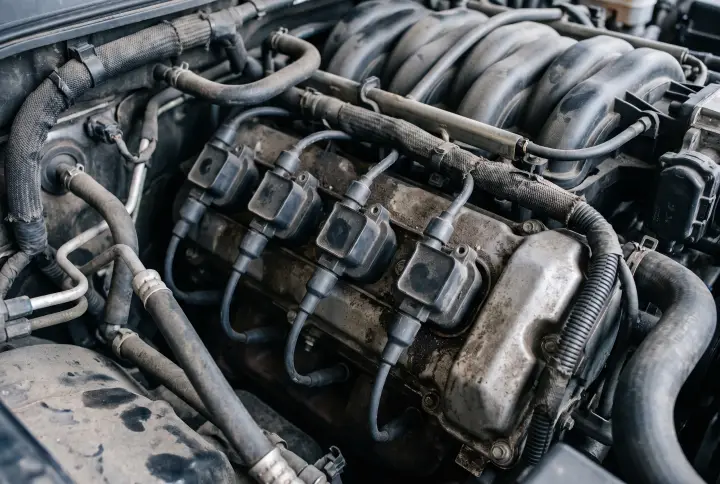
Finally, heat-degraded ignition coils on cylinders 5 and 6 ranked at 70 percent probability. Micro-cracks in the coil housings allow voltage to arc to the cylinder head when engine load increases in 'D'. Swapping these coils to Bank 1 and monitoring if the misfire follows is a standard verification step.
Diagnostic Priorities for the V8 Engine
When dealing with overlapping mechanical and ignition codes on this engine, start with the most accessible tests. Checking the crankcase vacuum at the oil cap and commanding the VarioCam solenoid via a tester takes minutes. If both systems pass, pulling the plugs on Bank 2 for a borescope inspection is the definitive next step to catch potential bore scoring before any parts are ordered.