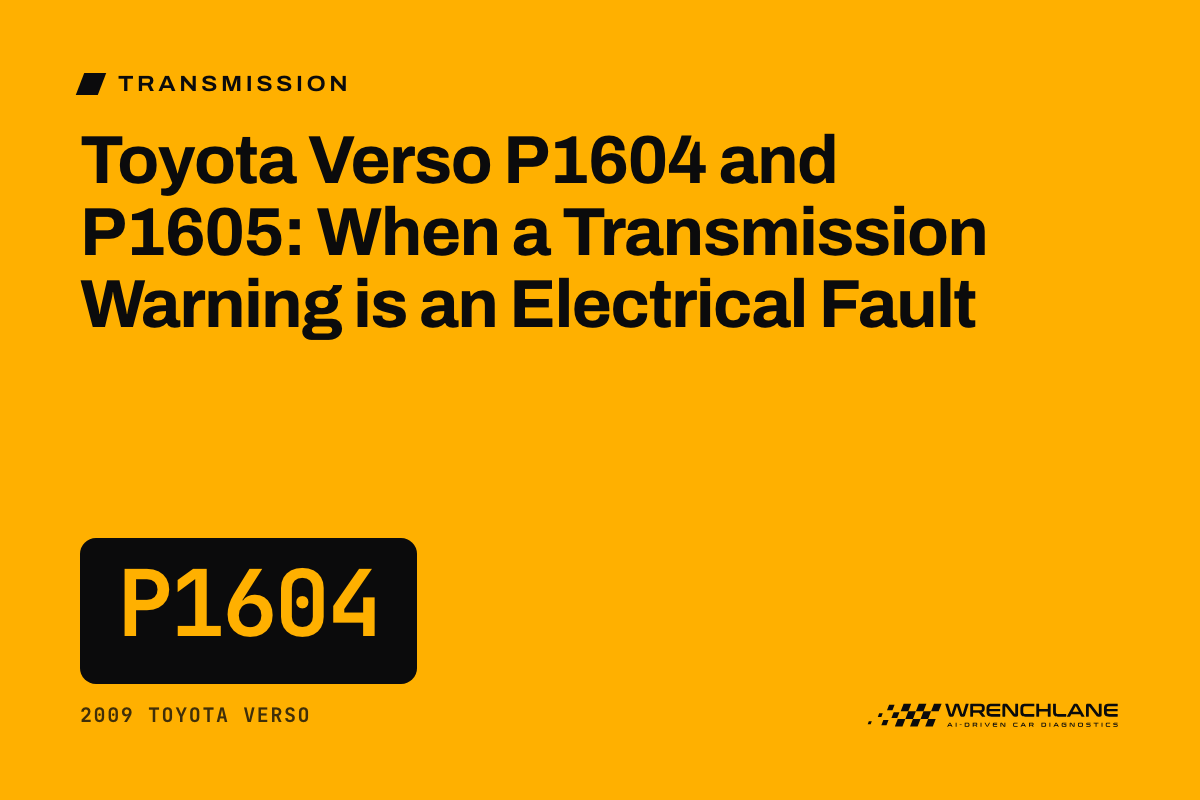
A customer brings in a 2009 Toyota Verso complaining about a transmission oil warning and a shifter that refuses to go into Drive, but the stored codes point to the engine control module. The technician noted that the car worked perfectly after simply turning it off and on again.
Transient power issues trigger phantom faults
The only codes stored were P1604 and P1605. At first glance, a transmission oil warning alongside a P1605 (Knock Control CPU Malfunction) seems like you are dealing with two massive failures. However, our diagnostic platform flagged a weak ground or power supply to the ECM as the 90 percent most likely cause. When voltage drops too low during the starting sequence, the ECM logs an internal CPU fault and drops communication with the CVT controller. That communication drop is what triggered the transmission warning and locked the shifter, not a mechanical failure.
Testing the power supply first
Before condemning a transmission or an engine computer, the data points to basic electrical integrity. The recommended first step is a voltage drop test between the battery negative terminal, the chassis, and the engine block. The platform also advises inspecting the grounds under the battery, on the driver-side strut tower, and at the cylinder head.
A weak starter battery ranks closely behind at 80 percent probability. Monitoring system voltage during cranking is critical here. If it drops below 10.5V, the ECM cannot maintain stable logic.
Ruling out the ECM and fuel system
If the power and grounds are clean, a genuine internal ECM failure sits at 70 percent probability, which would require checking for Toyota technical service bulletins regarding software updates or replacing the unit. At 60 percent, fuel system issues like low pressure (target is 44 to 50 psi) can cause an extended crank that starves the electrical system, indirectly setting the P1604 Startability Malfunction code.
Stop chasing the dash warning
This is a classic case where the dash display sends you to the gearbox, but the data sends you to the battery ground.