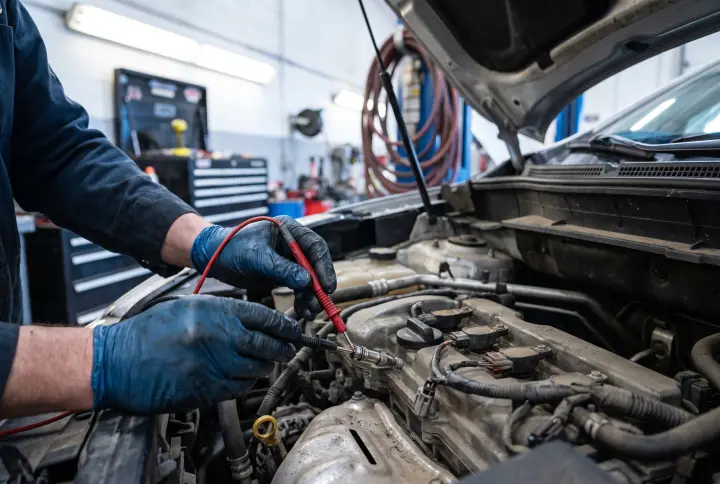
A 2014 Volkswagen Amarok arrived at the workshop with a straightforward complaint: the engine refused to start in sub-zero temperatures. A quick scan revealed a single fault code, P0380, logged in the engine control module. In temperatures above freezing, the high rail pressure of direct injection is often enough to fire up a 2.0 TDI (CSHA) engine. Below zero, the cold cylinder block absorbs so much heat that the fuel cannot self-ignite without external glow heat.
Glow plug deterioration on the 2.0 TDI
The diagnostic platform we build ranked defective glow plugs as the most probable cause at 82 percent. The heating elements in these plugs experience severe thermal fatigue over time. Eventually, they either burn out completely or develop a massive increase in internal resistance.
When one or more plugs fail, the current draw during the pre-glow phase drops. The J179 glow plug control unit registers this drop and flags P0380 in the EDC17C54 engine module. To verify this, measure the resistance with a digital multimeter directly across each glow plug to the cylinder head. You can also use a DC clamp meter on the wiring during the pre-glow phase to check the actual current draw.
Evaluating the glow plug control unit
If the plugs test fine, the next target is the J179 glow plug control unit, ranked as a 65 percent likelihood. This relay handles the pulse-width modulated voltage supply to the glow plugs. It also monitors the current consumption for each individual cylinder.
Internal faults are common here. Burned MOSFET transistors or cracked solder joints from constant thermal cycling will stop the voltage output entirely. Check the power supply at terminal 30 and the ground connection at terminal 31 under load. A solid test involves activating the system via bidirectional control on a diagnostic tool to measure the output signal directly.
Wiring harness and connection integrity
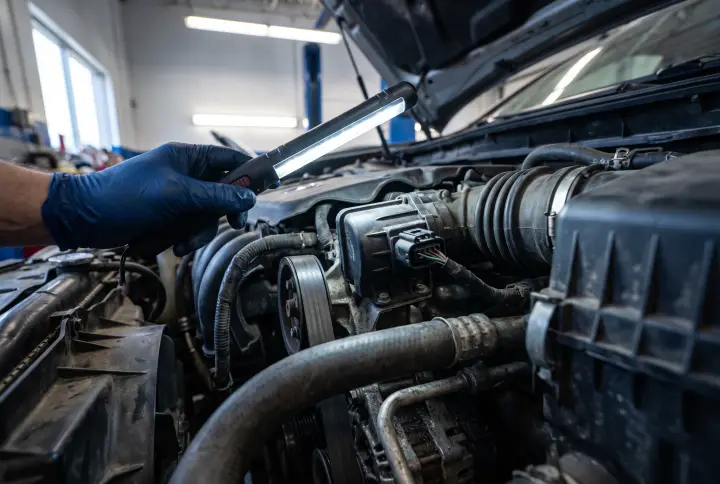
The glow plug bridge and wiring harness face constant engine heat, oil spray, and vibration. This ranks as a 40 percent probability for the P0380 code. Over time, the plastic connectors harden and break. Moisture then seeps into the terminals, causing green corrosion and high resistance.
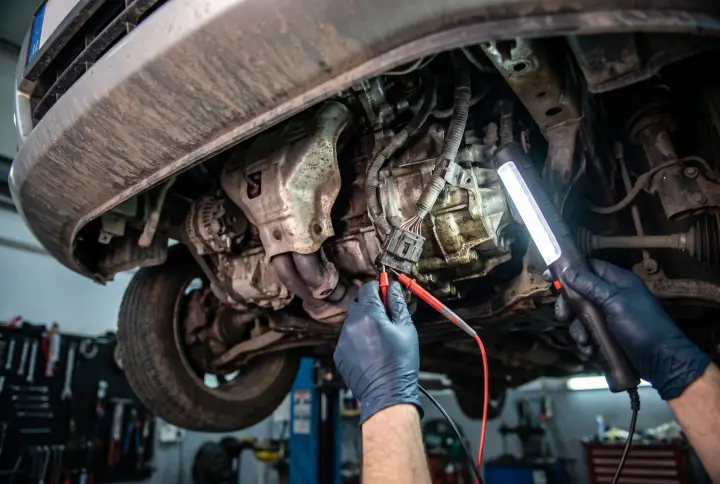
This resistance drastically lowers the voltage reaching the plugs, preventing them from hitting their required 850 to 1000 degrees Celsius for a cold start. Visually inspect the sockets for corrosion or mechanical deformation. A voltage drop test using a 21W or 55W test lamp under load will quickly highlight a failing harness.
Main fuse failures
A blown main fuse remains a 30 percent possibility. The glow plug system pulls power directly from the battery through a dedicated 50A or 60A fuse in the engine bay fuse box.
If a glow plug previously shorted to ground, or the wiring harness rubbed against the chassis, this fuse will blow. Without supply voltage, the engine module instantly sets the P0380 code and the engine will just crank without firing. Check for electrical continuity across the fuse. Always test for a short to chassis ground before installing a replacement.
What to check first on a no-start Amarok
Begin your diagnosis at the engine bay fuse box to rule out a blown 50A or 60A main fuse. If the fuse is intact, proceed directly to resistance measurements at the individual glow plugs. This specific case teaches that a solitary P0380 code requires a systematic check of the entire high-current circuit before replacing the control unit.
Reference pages for the codes in this article
- P0380: what we measure for this code across real diagnostics