A 2002 Hyundai Santa Fe arrived with a single U0009 fault code and a serious drivability complaint. The technician noted the engine would shut off completely and abruptly while driving, but only once it was fully warmed up.
Thermal shorts in the wiring harness
Our platform ranked a thermal short between CAN High and CAN Low as the most likely cause at 75 percent. On this 2.0 CRDi, prolonged driving at steady speeds pushes the engine bay to its maximum operating temperature. Harmonic vibrations and heat cause the insulation on the twisted CAN lines to fail, particularly near the cylinder head, the battery tray, or the firewall.
When thermal expansion forces CAN-H and CAN-L to touch, the differential voltage drops to zero. The Bosch EDC15C2 engine control unit instantly loses safety and synchronization messages with the immobilizer and ABS. The software immediately cuts injector operation to protect the system, killing the engine. A hot resistance test between pins 6 and 14 of the OBD-II port, alongside an oscilloscope check during a wiggle test, can confirm this.
When fuel pressure mimics a network fault
Ranked closely behind at 65 percent is excessive diesel backflow from the common rail injectors. As the D4EA engine and its fuel heat up past 60 degrees Celsius, diesel viscosity drops. If the control valve seats inside the injectors are worn, this thinner fuel rushes into the return circuit. The high-pressure pump cannot keep up, and rail pressure crashes below the critical minimum.
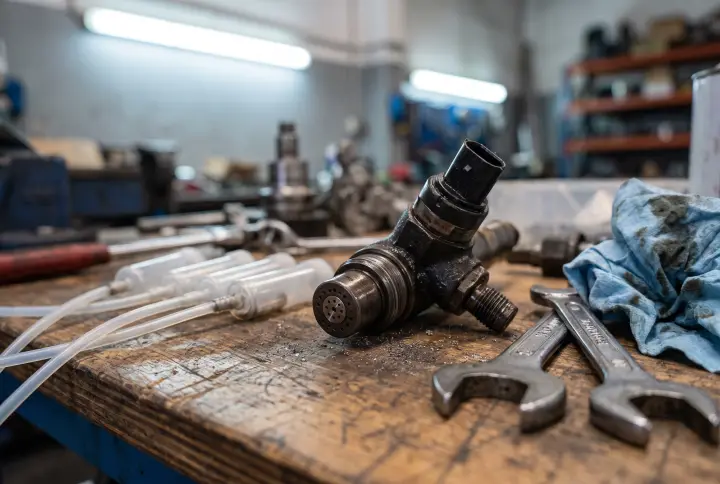
The ECU cuts fueling to protect the hydraulic system. Generic EOBD readers frequently misinterpret this sudden shutdown as a U0009 communication error rather than a specific fuel pressure code. A hot injector leak-off test using graduated burettes will quickly reveal if worn injectors are dumping fuel.
Hardware failures and supply lines
Two other heat-related failures round out the analysis. At 50 percent probability, the internal CAN transceiver chip inside the ECU suffers from thermal drift. Heat causes an internal short in the semiconductor or its solder joints. The system crashes, and the vehicle only restarts after the circuit cools down or the key is cycled multiple times.
At 45 percent, the low-pressure fuel pump in the tank loses flow volume when hot. Worn pump brushes or a clogged prefilter restrict fuel delivery to the high-pressure pump. A sudden loss of primary feed causes immediate cavitation and engine stall, which can again throw a misleading U0009 code on generic scan tools.
Where to start the diagnosis
Always reproduce the thermal conditions before testing. Since a mechanical fuel drop can trigger this specific electrical code, hook up graduated burettes to check hot injector return rates first. If the return flow is normal, connect an oscilloscope to the CAN network and physically manipulate the engine harness to hunt for the wiring short.