A 2015 Honda CR-V recently entered the workshop presenting only a single P2A00 fault code, manually entered by the technician as 'P2AOO'. This code points directly to a range or performance issue on the primary oxygen sensor circuit, but the root cause on this 1.6 i-DTEC engine often extends beyond the sensor itself.
Sensor Degradation and Thermal Fatigue
The diagnostic platform ranked internal degradation of the lambda sensor as the most likely cause at 78 percent probability with medium severity. On the 1.6 i-DTEC N16A2 engine, the sensor upstream of the diesel particulate filter is a Bosch LSU 4.9 planar wideband unit. The P2A00 code is triggered when the engine control module runs a rationality monitor during cruising speeds and deceleration fuel cut-off phases, comparing the pumping current to the expected stoichiometric value. Over time, the electrochemical zirconium cell or the compensation resistor suffers thermal fatigue, slowing the sensor response.
Suggested tests include measuring the heater circuit resistance with a multimeter and checking for a 12 V supply under load. Technicians should also monitor the pumping current signal during a deceleration fuel cut-off event to assess responsiveness.
Carbon Fouling on the Sensor Tip
Ranked at a 68 percent probability, carbon fouling is another major factor. Incomplete combustion or frequent short trips can create a dense accumulation of soot on the metallic protective cap of the Bosch LSU 4.9 sensor. This buildup blocks the slotted diffusion holes, restricting gas exchange to the internal ceramic cell. The restricted airflow dampens the response speed of the sensor, causing the control unit to detect a reading delay.
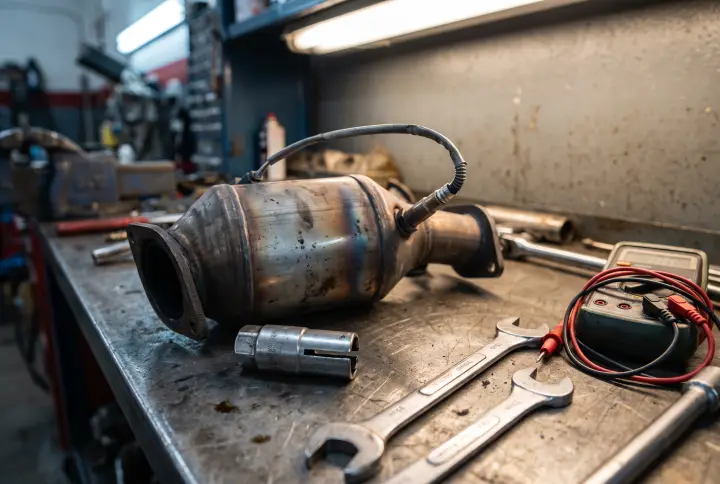
Removing the sensor with a 22 mm wrench allows for a direct visual inspection. Resolving this might involve controlled thermal cleaning of the ceramic element or an active regeneration of the particulate filter.
Upstream Exhaust and Intake Leaks
The system ranked an exhaust gas leak upstream of the lambda sensor at 55 percent. A leak at the exhaust manifold gasket, turbocharger joint, downpipe flange, or even the sensor threads allows parasitic air into the stream due to exhaust pressure pulses and the Venturi effect. This fresh oxygen creates a false lean reading. To verify this, run a smoke test on the exhaust at approximately 0.4 bar and check the sensor fastening torque, which should be roughly 45 Nm.
At 45 percent probability, intake leaks or a dirty mass air flow sensor can also cause this code. The engine control module calculates expected exhaust lambda based on measured fresh air mass and injected fuel. A boost leak or a contaminated hot wire on the mass air flow sensor creates a continuous discrepancy between the measured airflow and actual engine conditions.
Initial Diagnostic Steps
Always verify the physical integrity of the exhaust tract before replacing electronic components. A visual inspection of the sensor cap for severe soot blockage, combined with a low-pressure exhaust smoke test, will quickly confirm or rule out mechanical air intrusion before you move to electrical circuit testing on the Bosch LSU 4.9 sensor.
Reference pages for the codes in this article
- P2A00: what we measure for this code across real diagnostics