When a 2016 Porsche Panamera (971) II arrives with a check engine light and five distinct fault codes, the diagnosis often stalls on whether the codes share a single root cause. In this case, the vehicle presented with a basic "motorlampa" complaint and logged P014000, P01600, P016100, P014100, and P125000.
Unpacking the Oxygen Sensor Codes
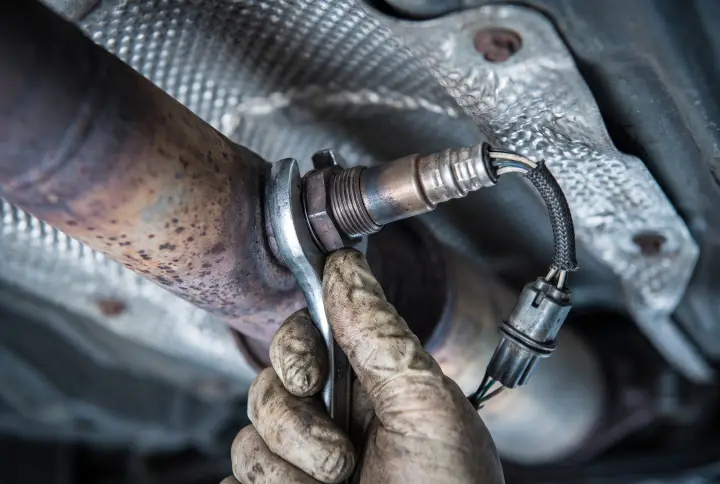
The presence of P014100 and P016100 simultaneously indicates heater circuit malfunctions on both Bank 1 Sensor 2 and Bank 2 Sensor 2. On the 2.9 V6 Biturbo (CSZ) engine, these downstream sensors share a common 12V supply circuit via a single fuse. Our platform ranked a blown fuse or voltage loss as the primary cause at 85 percent probability. Without power to the heating elements, the sensors cannot reach their operating temperature of approximately 600 degrees Celsius in the cooler downstream exhaust flow. They remain inactive, stuck at the engine control unit bias voltage of around 0.45V, which subsequently triggers the P014000 and P01600 inactivity codes.
Inspecting the Hot-V Wiring Harness
If the shared fuse is blown, the technician must locate the short to ground. Our diagnostic engine ranked heat or pinch damage to the wiring harness at a 60 percent probability. The Panamera's turbochargers and catalytic converters sit in a central hot-V arrangement. The wiring for the downstream sensors runs under aluminum heat shields and along the transmission cover. Contact with a hot exhaust pipe or pinching against the stabilizer bar will short the heater circuit, instantly blowing the shared fuse and knocking out both sensors. Visual inspection of this harness and measuring insulation resistance to chassis ground are the primary diagnostic steps here.
The Unrelated Low Fuel Code
The fifth code, P125000, ranked at 75 percent probability for its specific trigger condition, is entirely independent of the oxygen sensor faults. The engine control unit sets this code when the fuel level drops below a critical threshold, typically under 10 to 15 percent. This acts as a block condition. The control unit suspends certain OBD monitors, including EVAP diagnostics and misfire monitoring, to prevent false alarms or catalytic converter damage from fuel starvation. The correct test step is to simply verify the fuel level and add at least 20 liters to see if the code changes to a passive state.
Diagnostic Takeaway
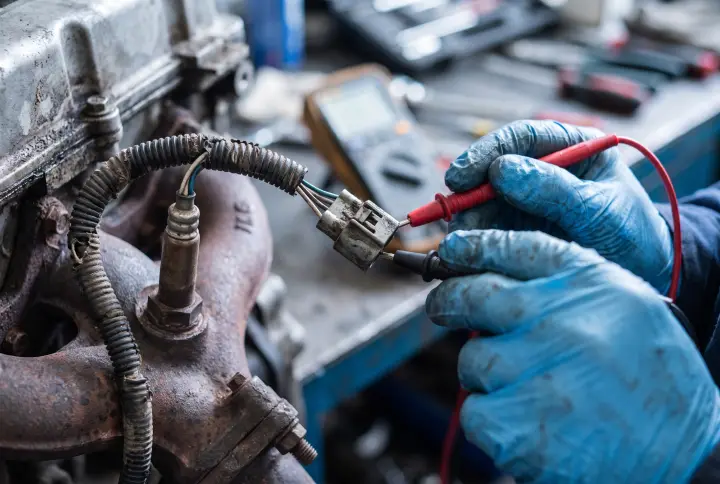
When a vehicle logs simultaneous heater codes for sensors on opposite engine banks, always consult the wiring diagram for shared power supplies before condemning the components. The first physical step on this Panamera is to test the continuity and voltage of the shared oxygen sensor heater fuse with a multimeter, followed by a close inspection of the wiring harness routed behind the catalytic converters.