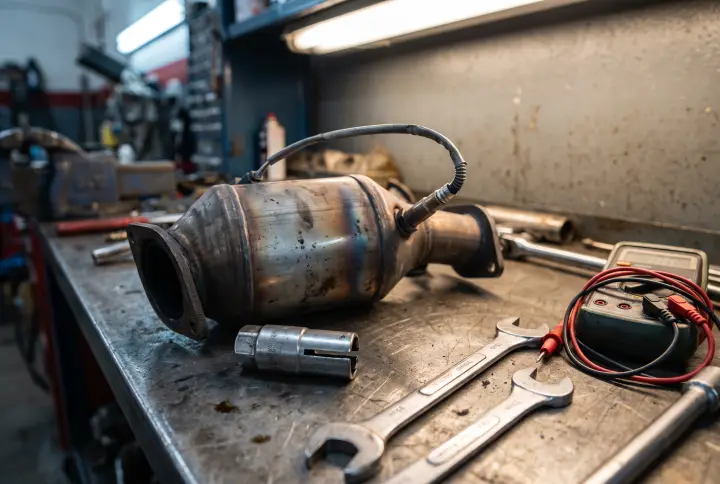
A 2020 Mazda 6 (GJ, GL) arrived in the bay with a persistent P0420 fault code, even after a new aftermarket catalytic converter had been fitted. The technician noted that the error simply would not clear, turning what should have been a straightforward parts replacement into a diagnostic stall.
The downstream sensor trap
The diagnostic platform we build ranked a sluggish downstream oxygen sensor (Bank 1 Sensor 2) as the primary suspect, giving it a 78 percent probability. The engine module evaluates catalytic converter efficiency by comparing the front air-fuel ratio sensor with this rear zirconia sensor.
If the original downstream sensor was left in place during the converter replacement, its natural degradation can cause it to oscillate too quickly or drift in voltage. The module interprets this rapid switching as a lack of oxygen storage capacity in the new converter, triggering the P0420 code again.
Fresh air leaks mimicking failure
Coming in at a 72 percent likelihood was a minute exhaust leak near the new converter or the sensor port. Whenever flange connections are separated and metal-graphite gaskets are replaced, minor sealing failures can occur.
Thanks to the Venturi effect, exhaust pulsation sucks fresh atmospheric air into the pipe. This extra oxygen hits the downstream sensor directly. The engine control unit reads the high oxygen content and assumes the converter is not oxidizing gases, logging a fault despite a perfectly healthy new core.
The reality of aftermarket converters
Our data showed a 65 percent chance that the new aftermarket converter simply lacked sufficient oxygen storage capacity. Modern engine management software monitors this buffer constantly.
Non-genuine replacements often use a lower density of precious metals or a sparser cell structure, such as 300 to 400 cells per square inch, compared to the factory unit. These converters might pass a basic idle emissions test but fail the continuous monitor during steady driving.
Front sensor instability
The platform also flagged the front wideband sensor (Bank 1 Sensor 1) at 60 percent probability. During a deceleration fuel cut-off, the sensor reading should transition smoothly to a stable lean value.
If the signal shows spikes or noise when the throttle is released, it points to a failing measurement cell or a heater circuit defect. This erratic signal causes fuel trim fluctuations in closed loop, destabilizing the entire exhaust chemistry.
Where to start the diagnosis
Before condemning a brand new converter, connect a scan tool to graph the live voltage of the downstream sensor at a steady cruising speed. Follow this up with a smoke machine test on the exhaust flanges to rule out unmetered air entering the pipe. A quick pyrometer check of the temperature difference between the converter inlet and outlet will confirm whether the core is actually functioning.
Reference pages for the codes in this article
- P0420: what we measure for this code across real diagnostics