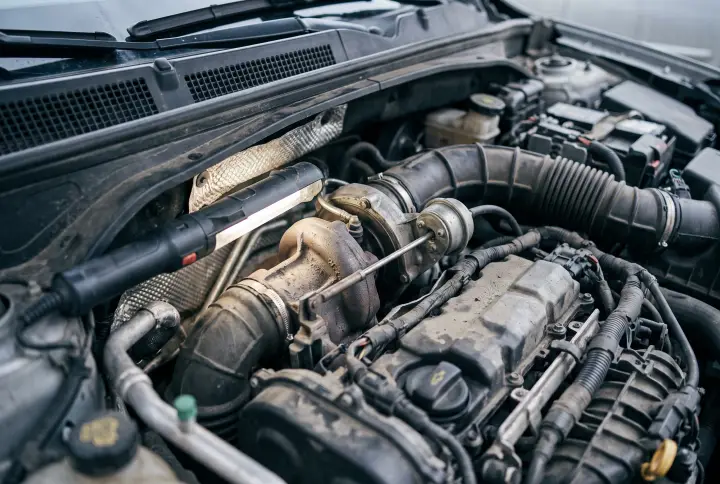
A 2018 Chevrolet Traverse recently came through the bay with a single P0621 fault code and a persistent "Check Charging System" warning on the dash. Our diagnostic platform analyzed this specific fault for the GM 3.6L LFY V6 engine, where the Engine Control Module monitors and controls generator load using the generator turn-on signal circuit, commonly known as the L-terminal.
Evaluating the Internal Voltage Regulator
Our data ranks an internal voltage regulator failure within the alternator as the most likely culprit at 65 percent. A solid-state voltage regulator inside the alternator assembly cycles the rotor field circuit based on commands from the Engine Control Module. When the internal driver transistor, brush pack, or sensing diodes degrade, the regulator fails to pull the signal low or maintain proper feedback.
The engine control system evaluates this circuit continuously. During Key-ON Engine-OFF, it expects to see under 1.0 V. During Engine-RUN, it looks for over 3.5 V. If the circuit remains low for 15 seconds while commanded high, or high when commanded low, the P0621 code sets. Technicians should start by testing the charging system voltage output at idle and under electrical load, followed by measuring the L-terminal signal voltage during both engine-off and engine-run conditions.
Inspecting Circuit 2540 for Open or Short Conditions
Wiring issues account for 20 percent of these cases in our records. The generator turn-on signal circuit, designated as Circuit 2540, is a dedicated single wire running between the engine computer and the alternator connector. On these transverse V6 platforms, the engine harness routes past lifting brackets, cylinder heads, and air conditioning lines.
Engine torque movement and thermal cycling often cause the protective plastic conduit to wear through. This allows the signal wire to chafe against bare metal or break internally. A short to ground or an open circuit causes the module to detect an out-of-range voltage for 15 seconds, triggering the same fault. A visual inspection of the harness routing is necessary, alongside an end-to-end resistance test and an isolation test for shorts to ground or power.
Checking for Terminal Fretting at the Alternator
At a 12 percent likelihood, connector terminal fretting or poor pin tension presents a medium severity risk. The electrical connector at the alternator sits in an environment subjected to high ambient heat, engine vibration, and road contaminants. Micro-motion between the male alternator pins and female harness terminal sockets causes fretting corrosion or spreads the female terminal.
When pin drag tension is lost, the resulting microscopic gap creates intermittent high resistance in the L-terminal circuit. This distorts the signal back to the module and triggers the P0621 code, even if the hardware itself is perfectly fine. The prescribed test is a connector terminal pin drag test using a matching GM test probe, combined with a visual check for oil, green corrosion, or pushed-out pins.
Verifying the Control Module Driver
Internal failures within the Engine Control Module are rare, ranking at just 5 percent, but they carry a high severity. The module regulates generator field output using an internal high-side solid-state driver. If this circuit board suffers from a shorted output driver transistor, cracked solder traces from thermal cycling, or a logic failure, it cannot correctly pulse the circuit.
In this scenario, a brand new alternator and intact harness wiring will not clear the P0621 code because the module registers an internal circuit fault. Confirming this requires using a scan tool for bi-directional control of the L-Terminal duty cycle, as well as performing loaded voltage drop tests on the module power supply and ground.
The First Diagnostic Steps
The most efficient path through this diagnostic starts with isolating the alternator from the wiring harness. Performing the L-terminal signal voltage test in both Key-ON Engine-OFF and Engine-RUN states will quickly indicate whether the alternator is failing to respond or if the signal is being lost in Circuit 2540. Verifying pin drag tension at the connector before replacing any parts prevents the common mistake of condemning a healthy alternator over a loose terminal.
Reference pages for the codes in this article
- P0621: what we measure for this code across real diagnostics