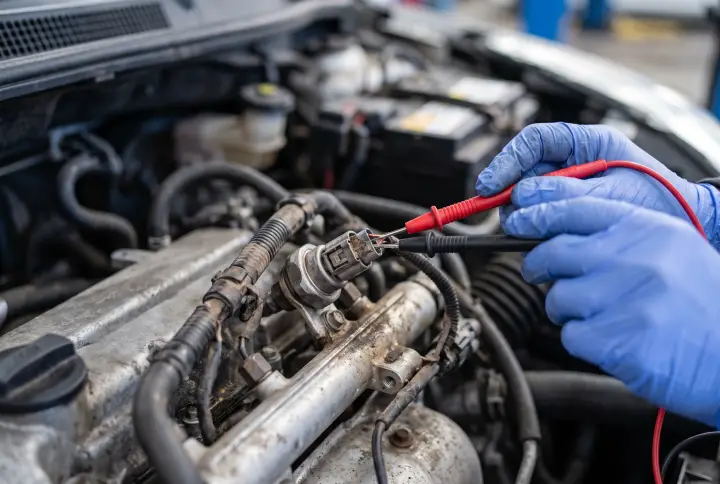
When a 2019 Mercedes GLE arrives with intermittent power loss and an illuminated check engine light, multiple fuel pressure codes usually point to a complex diagnostic path. A technician recently faced exactly this scenario with a 2019 Mercedes GLE V167. The vehicle logged P00870A, P0087FA, P0087FB, and P228E00. The customer complaint was simple: intermittent lack of power and an active engine warning light.
The danger of assuming pump failure
Seeing P228E00, which indicates the fuel pressure regulator exceeded its learning limits, alongside various P0087 low rail pressure codes, often prompts workshops to suspect major hardware failure. The high-pressure fuel pump on the OM656 engine operates at up to 2500 bar under maximum load. Mechanical wear on the roller tappets or internal check valves will absolutely cause rail pressure to drop by over 200 bar during acceleration.
However, our diagnostic platform ranked a mechanical pump failure third, at a 65 percent probability. Before testing for metal shavings in the quantity control valve or logging rail pressure build-up during cold cranking, the data pointed elsewhere.
Tracing the low-pressure side
Our engine ranked air ingress or flow restriction at a recently replaced fuel filter as the most likely cause, at 82 percent. The Mercedes OM656 fuel system is highly sensitive to the smallest air pocket or restriction on the low-pressure side. If the quick connectors on the fuel filter fail to seal completely due to a damaged O-ring, micro-bubbles are drawn into the fuel under a vacuum.
This leads directly to cavitation in the high-pressure pump. Because air is compressible, fuel pressure drops drastically during high demand situations like overtaking or driving up an incline. The engine control unit tries to compensate by adjusting the pressure regulation to its maximum limit, triggering the P228E00 code.
Regulator valve and feed pump factors
Sticking or leaking fuel pressure regulating valves ranked next at 76 percent. Microscopic deposits can cause the internal slide of the regulating valve to stick, or deformed O-rings can allow fuel to leak internally back to the return line. A technician can verify this by monitoring the PWM duty cycle and adaptation values through diagnostic tests.
A worn in-tank low-pressure fuel pump also factored in at 52 percent. If the electric feed pump cannot maintain a stable 4.5 to 6.0 bar of pre-pressure, the high-pressure pump is starved of volume. Measuring the feed pressure on the low-pressure side with a mechanical pressure gauge quickly rules this out.
Diagnostic takeaway
When dealing with P0087 and P228E00 codes on a modern diesel, always verify the integrity of the low-pressure side before condemning the high-pressure components. A visual inspection of the fuel filter connections for diesel smell or weeping, combined with a clear test hose to check for air bubbles, takes only minutes. Fixing a poorly seated filter connector prevents an unnecessary and expensive high-pressure pump replacement.
Reference pages for the codes in this article
- P0087: what we measure for this code across real diagnostics