A 2006 Saab 9-3 rolled in with a rough idle, lacking power, and throwing a P1682 alongside a P0638. At first glance, you might suspect a bad throttle body, but the real culprit is usually hiding under the battery tray. The technician simply wrote on the ticket, "RUNS ROUGH AT TIMES, LACKS POWER".
When you see a throttle actuator control range or performance code (P0638) paired with an ignition circuit plausibility fault (P1682), the instinct is often to go straight for the throttle body. It is a visible, mechanical component that gets dirty and fails. But the diagnostic platform we build analyzed these two codes together and pointed the diagnosis in a completely different direction, ranking a wiring connector as the most likely root cause.
The voltage drop at Connector H42-2
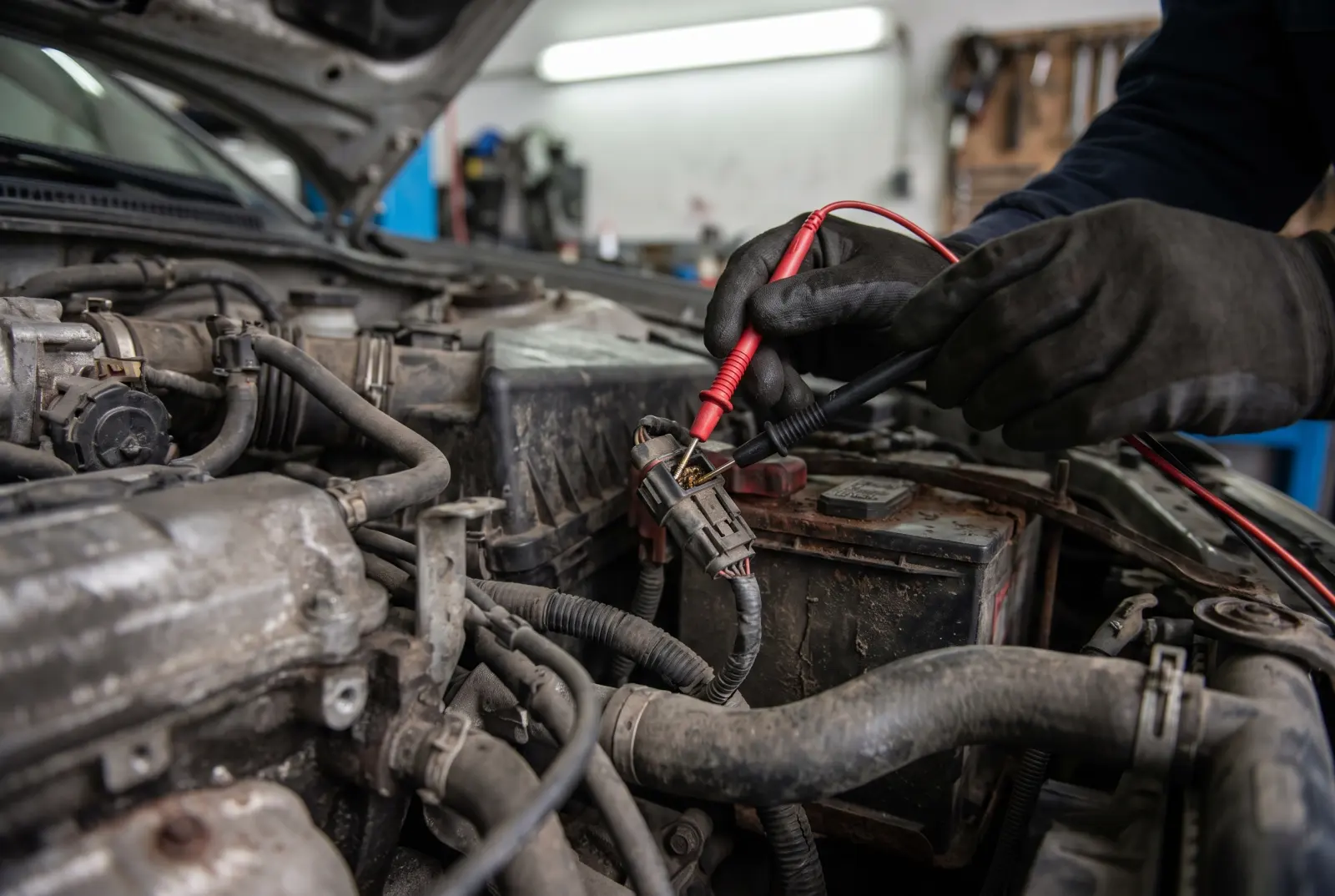
The highest probability cause, ranked at 90 percent with a medium severity, was dislodged or corroded pins in Connector H42-2. This connector sits underneath the battery tray. It is exposed to the elements, battery acid vapors, and general moisture, making it a prime location for intermittent electrical connections.
This specific connector handles the power supply to the Engine Control Module (ECM) and critical circuits, including those for the throttle actuator and the accelerator pedal position sensor. Specifically, pins 13, 14, 17, 18, 19, and 20 in H42-2 carry these vital signals. When corrosion builds up or pins lose their tension, the voltage drops. The ECM misinterprets this unstable reference voltage as a plausibility fault in the ignition circuit (triggering P1682) and a range or performance issue with the throttle actuator (triggering P0638).
There is even a Saab Technical Service Bulletin (TSB 248-2423) that highlights this exact connector as a common root cause for both of these diagnostic trouble codes, noting that it frequently leads to unnecessary throttle actuator replacements. The correct diagnostic step here is not ordering parts, but performing a visual inspection of the pins and a terminal tension test.
Internal faults within the Trionic 8 ECM
If the connector checks out, the next logical step targets the Engine Control Module itself. Our engine ranked a faulty Trionic 8 ECM as an 80 percent probability with a high severity.
The Trionic 8 ECM in this vehicle monitors its own power supply from two distinct sources. One comes directly from the ignition switch on circuit +15, and the other arrives via the main power relay. If an internal component fails within the voltage monitoring circuits of the ECM, it will incorrectly report a power supply disagreement. This triggers the P1682 code. Because the internal fault also disrupts the stability of the voltage supply sent out to the throttle actuator control, the P0638 code follows closely behind, bringing the rough running and lack of power symptoms with it. Testing this requires a visual inspection of the ECM connector pins and checking the ECM ground resistance.
Power distribution at the Underhood Electrical Center
Ranked just below the ECM at a 70 percent probability was a fault in the Underhood Electrical Center (UEC), the main relay, or the ECM ground.
The UEC functions as the primary fuse box and power distribution module for the engine bay. Internal corrosion or cracked solder joints within the UEC can choke off power delivery. Similarly, a failing main power relay (often labeled T8 or Engine Management) will cause intermittent power loss to the ECM and the ignition circuits. A poor ground connection for the ECM at location G7 can cause identical voltage discrepancies. Any instability here sets the P1682 code and disrupts throttle actuator power, leading directly to the P0638. The required tests are swapping the main power relay, visually inspecting the UEC relay sockets, and performing a voltage drop test at the UEC fuses.
The throttle body itself
Interestingly, the electronic throttle body (ETB) assembly ranked lowest in our data for this specific combination of codes, coming in at a 60 percent probability.
The B207R throttle body is highly sensitive to reference voltage. While internal wear on the motor or position sensors can cause the throttle plate to lose track of its desired position, and carbon buildup can cause mechanical binding, these are less likely to be the root cause when accompanied by a P1682 power supply disagreement code. Minor internal ETB issues are severely exacerbated by the power supply problems occurring upstream at the battery tray or the UEC.
Have you found yourselves replacing throttle bodies on early 2000s European cars only to have the same codes return a week later?