A 2008 Ford F-250 Super Duty came into the bay logging a U0101 fault code for lost communication with the transmission control module. The technician noted the fault appeared shortly after the TCM had been replaced, causing the PRNDL display to drop out whenever the diesel engine was started.
Our diagnostic platform analyzed the symptoms and the specific U0101 code to map out the most probable failure points. On the 6.4L diesel equipped with the TorqShift 5R110W transmission, the physical location of the module and the vibration of the engine play a major role in network stability.
Connector Integrity After Module Replacement
Our platform ranked a compromised TCM connector terminal as an 82 percent probability for this specific scenario. The standalone TCM on this truck is externally mounted along the driver side frame rail. Because this fault developed immediately after a module replacement, the primary suspect is the weather-beaten wiring harness connector itself.
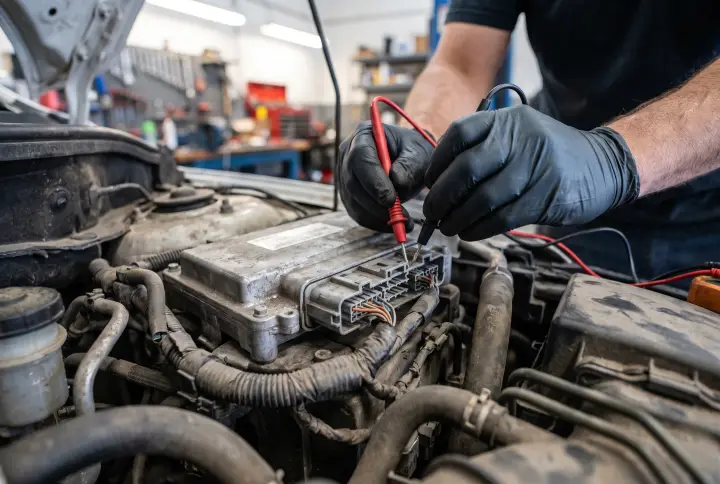
Reconnecting this multi-pin connector frequently results in unlatched secondary locks or backed-out pins. The most critical cavities to check are CAN-H on pin 47, CAN-L on pin 48, and the main power and ground feeds. When the diesel engine cranks, chassis resonance immediately breaks the weak pin-to-terminal contact. This severs the network connection, logs the U0101 code in the powertrain control module, and extinguishes the PRNDL indicator.
To verify this, technicians should perform a terminal drag test using an OEM male pin probe on the suspect cavities. A visual inspection of the connector locking lever and the rubber weather seal is also necessary, followed by a harness wiggle test while monitoring live CAN data.
Harness Chafing and Ground Offsets
If the connector pins are secure, the next structural vulnerability is the High-Speed CAN bus wiring. Ranked at a 78 percent probability, chafing in the harness bundle is highly common on examples with around 240,000 miles. The White and Blue CAN-H and White CAN-L wires run along the frame rail, routing over the front shock tower and through inline connectors like C1010 toward PCM connector C175T. Constant frame flex and contact with metal brackets cause internal wire fatigue. Engine roll during startup immediately grounds or opens the CAN line.
A compromised ground reference will also knock the TCM offline. Ranked at 72 percent, corrosion at chassis ground G100 on the passenger side radiator support, or the dedicated frame eyelet under the cab, creates a massive voltage drop. When high-current electrical loads like glow plugs and twin alternators energize, the ground plane shifts. This offset starves the internal processors of the TCM. A dynamic loaded ground voltage drop test with the key on and engine running will confirm if the ground circuit is intact.
Module Programming and Production Splits
Replacing a control module on a 2008 Super Duty is not a simple plug-and-play operation. Our data flags a 65 percent probability that the new TCM was either incorrectly specified or not programmed properly.
Ford implemented a critical mid-year production split for this model year. Vehicles built on or before July 29, 2007, require a different hardware and calibration unit (OEM part 8C3Z-12B565-A) than those built on or after July 30, 2007 (OEM part 8C3Z-12B565-B). An incompatible module revision will be rejected by the PCM upon startup. Additionally, the module requires dealer-level software to perform a Programmable Module Installation, match the VIN, and configure the Vehicle Identification block.
Diagnostic Priorities for U0101
When a U0101 code appears following a module replacement on a 6.4L Super Duty, always verify the physical connections before condemning the replacement part. Check the connector seating, test the grip tension on pins 47 and 48, and confirm the module part number matches the specific build date of the truck. Ensuring the correct software installation and validating the physical ground circuits will keep a diagnostic process moving forward efficiently.
Reference pages for the codes in this article
- U0101: what we measure for this code across real diagnostics