A 2012 Mercedes-Benz Sprinter II comes into the bay with an illuminated check engine light and a single fault code: P032B00. While a generic scanner defines this as a knock sensor circuit fault, treating it strictly as a knock sensor issue on this specific engine often leads to wasted diagnostic time.
The Manufacturer Logic Behind P032B00
Our diagnostic platform data shows that on the Mercedes-Benz OM651 engine, which uses a Delphi Common Rail system, the generic OBD code P032B00 is attributed directly to the Crankshaft Position sensor circuit in the manufacturer logic. The ECU calculates the angular acceleration of each cylinder by analyzing high-resolution pulses from the CKP sensor.
If the CKP sensor develops internal thermal degradation or voltage threshold drift, the Delphi ECU struggles with fine rotational synchronization during the first 5 seconds after startup. To prevent stalling, it adopts a safety strategy with transitional fuel and timing advances. This causes a distinct symptom where the engine over-revs for 5 seconds. Once the digital filter validates the signal, the idle normalizes and the vehicle drives well, but the P032B00 code remains active.
Testing Sensors and Acoustic Response
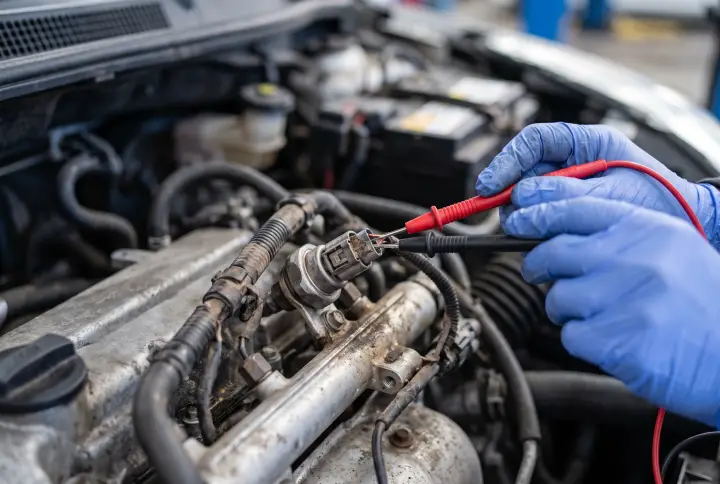
The primary diagnostic step is measuring the digital CKP signal waveform and frequency with an oscilloscope during cranking and the initial 5-second startup phase. You must also check the 5V or 12V reference voltage, the sensor ground, and monitor the signal cold versus at an operating temperature of 85 to 90 degrees Celsius.
The OM651 is also equipped with piezoelectric combustion noise sensors on the engine block to measure pre-injection noise. If the piezo element suffers from thermal fatigue or poor block contact, the ECU suspends pilot fuel calibration at startup, temporarily increasing RPM. It is critical to check the tightening torque of the sensor on the block with a torque wrench, as incorrect clamping distorts the acoustic response.
Wiring Degradation and Reluctor Debris
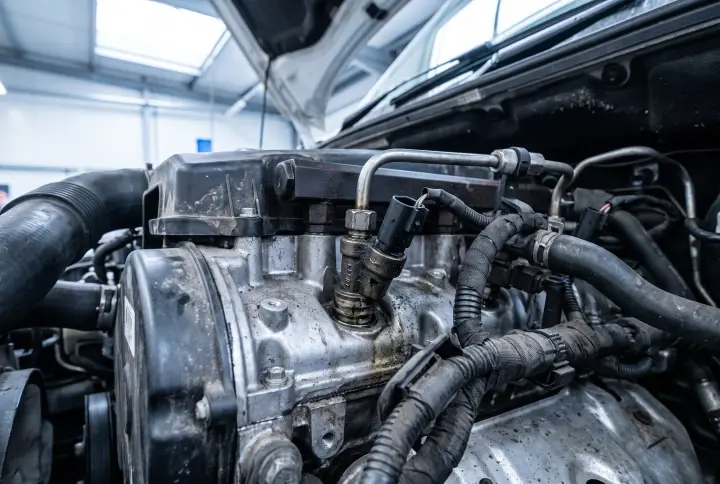
The lower engine wiring harness near the starter and oil filter housing is subjected to intense vibration and thermal cycling. Connectors here often suffer from oil contamination or fretting, which is microscopic pin corrosion. A micro-resistance change on the signal or ground wire alters the voltage read by the Delphi ECU analog-to-digital converter, triggering the fault code even if the sensor is healthy.
Contamination on the reluctor ring is another physical cause. Magnetic metal shavings, friction dust, and oil can accumulate on the tone ring teeth. At cranking speeds of 200 to 250 rpm, these deposits distort the magnetic field. The ECU interprets these asymmetrical readings as abnormal rotation, generating the P032B00 code before centrifugal force cleans the signal at higher RPMs.
What to Check First
Start your diagnosis by scoping the CKP sensor signal during a cold crank, specifically watching the first 5 seconds of operation. Follow up with a close visual inspection of the lower engine wiring harness for oil ingress or fretting at the connectors. This case demonstrates that taking a generic fault description at face value can obscure a complex synchronization fault in the engine management logic.