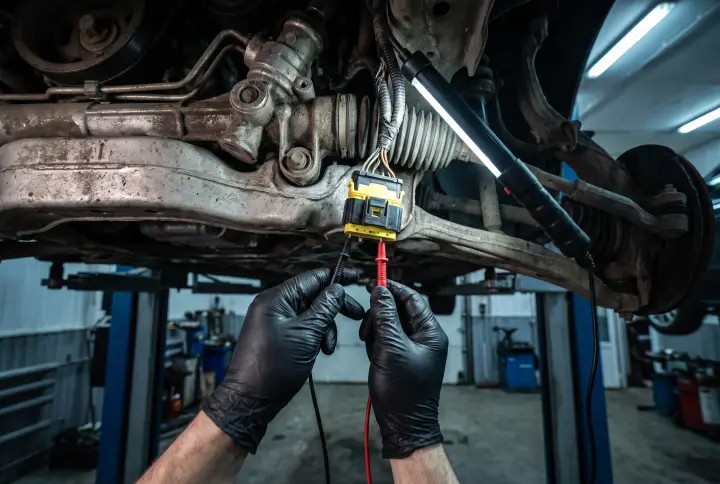
A 2020 BMW 3 Series arrived with a strange symptom after a standard 12V battery replacement: a scraping noise under the car every second when parked. The technician had already replaced the battery and registered it with the correct voltage, but fault codes CD8403 and CDC15E refused to clear. These codes point to network issues, but the physical scraping noise in park pointed to a mechanical activation happening on a continuous loop.
Tracing the dynamic stability control power supply
Our diagnostic platform ranked a power supply failure or a blown fuse to the DSC and VIP control units as the most likely root cause, at 85 percent probability. When multiple control units complain simultaneously about missing or invalid signals from the DSC and the advanced driver assistance systems, it usually points to a central communication loss.
The codes CD8403 and CDC15E indicate that the DME is not receiving the torque request via FlexRay. After a 12V battery replacement, a main fuse to the chassis control modules can easily trip upon reconnection. If the DSC loses its power supply at Terminal 30 or 15, communication drops across that entire bus branch. The first test step is measuring the supply voltage directly at the DSC connector and visually checking the fuses in the front power distribution box.
Explaining the rhythmic scraping noise
The 80 percent probability match explained the one-second scraping noise. In this BMW architecture, the electromechanical parking brake is controlled by the DSC unit via actuators on the rear calipers.
When DSC communication fails, the vehicle speed signal is marked invalid. Without confirmation that the vehicle is stationary, the parking brake control unit can enter a cyclic emergency calibration. It searches for its position every second while the vehicle is in park. This periodic activation of the spindle motor against the brake pad generates the exact scraping or clicking noise the technician reported. The recommended diagnostic path is an acoustic and mechanical inspection of the rear caliper actuators with the vehicle lifted, combined with reading live data for actuator current draw.
Verifying the FlexRay and body domain controller
The platform also flagged a potential FlexRay bus interruption on the DSC branch at 70 percent probability. FlexRay requires precise termination to maintain signal integrity. If a cable was pinched in the luggage compartment during the battery swap, the bus would collapse. Testing requires measuring the bus resistance between FlexRay Bus Plus and Bus Minus.
Additionally, a Body Domain Controller short-circuit block was identified as a secondary factor. BMW electrical architectures will permanently disable an output if it registers more than 50 short circuits. This requires a software reset once the underlying wiring fault is repaired.
Where to start on this repair
When a vehicle presents with communication faults and a cyclic mechanical noise immediately following a battery replacement, start by verifying the primary power circuits. Checking the Terminal 30 and 15 fuses for the DSC and visually inspecting the battery area for pinched FlexRay cables will save hours of chasing network ghosts. The scraping noise is a secondary symptom of the missing speed signal, so resolving the DSC power supply will often correct the parking brake behavior automatically.